By William E. Porter, Jr., M.Div.
CONTENTS
- INTRODUCTION: THE NATURE OF THE CHALLENGE
- CURRENT TRENDS IN CULTURAL DECONSTRUCTION
- A LOOK AT RECENT HISTORY: WHERE THE CULTURAL DECONSTRUCTION BEGAN
- A DEEPER LOOK: THE PSYCHE OF ALTERNATIVE SEXUALITY
- A BIBLICAL REVIEW OF SEXUALITY
- NAVIGATING THE CHALLENGES OF THE ‘POST-CHRISTIAN’ WORLD
- IN THE WORLD – NOT OF THE WORLD: LOVING THE SINNER WHILE HATING THE SIN
I. INTRODUCTION: THE NATURE OF THE CHALLENGE
Many years ago, when I was in seminary, I was talking with my Systematic Theology professor about how culture and politics influences the thinking and expression of beliefs, especially religious beliefs. In the midst of our discussion, my professor stated, “You need to be aware of the erosion of the truth by the influence of ‘frog theology’.” The professor then went on to explain that if you wanted to boil a living frog in a pan, you couldn’t just drop it in boiling water, as the frog would immediately jump out due to the intensity of the heat. However, if you put the frog in lukewarm water it would feel quite comfortable, and all you would need to do then, would be to slowly turn up the heat one degree at a time. The frog would then slowly be sapped of strength and eventually pass out, succumbing to its fate.
In the same way, the devil slowly alters the established understanding of the truth of the Sacred Scriptures, one degree at a time, incrementally moving the boundary lines of acceptability with compromise. This happens not only in the field of biblical interpretation, but also in biblical practice, the result being that our Orthodoxy (right belief) becomes watered down and our Orthopraxy (right practice) becomes morally undistinguishable from the secular lifestyles of the world.
One does not need to look far to see how the good seeds of faith and godliness are becoming choked out by the weeds of political correctness. Words like ‘acceptance,’ ‘tolerance,’ and ‘inclusion’ have been hijacked and used, ironically, to insinuate that anyone who does not accept the modern and liberal definitions of human identity and sexuality should be silenced. The message in society is that a person is considered to be “intolerant” and “judgmental” if they do not graciously accept the ideologies and practices of people of “alternative lifestyles” and “sexual orientations” no matter what the Scriptures and the Holy Church may have to say about it. And even though there are a number of issues over which Christians can ‘agree to disagree,’ sexual morality and being made in the image of God, ‘male and female,’ is not a relative and interpretive reality within the Body of Christ, but a given fact of creation.
This brings to mind the secular mantra within the ‘pro-choice’ abortion movement, with women emphasizing their conviction that “It’s my body, I have a right to choose and do what I want with it.” It is almost as if God no longer has the right to tell people how to live anymore; or at least God needs to ‘dialogue’ with us first, so that we can make sure that no one will find any of His commandments, laws or principles offensive. It’s as if all religious instruction and doctrine must now fit within the ‘acceptable boundaries’ of our own evolutionary and cultural understanding, or at least our personal comfort zone!
In contrast to this, the Holy Scripture says to the Christian:
Do you not know that your body is a temple of the Holy Spirit, who is in you, whom you have received from God? You are not your own; you were bought (redeemed) at a price. Therefore honor God with your body (I Corinthians 6:19-20).
What could be more abhorrent to modern thought than to be told you cannot do what you want with your body, because you are actually called to submit yourself to God to honor Him instead of yourself!
Though the Orthodox Church has managed to maintain its biblical, apostolic, historical and traditional stance on the nature of the family, as intended by God at creation, there are viewpoints and movements stirring within Orthodoxy that are blatantly attempting to question and challenge that stance.
II. CURRENT TRENDS IN CULTURAL DECONSTRUCTION
On the website of The American Conservative, an article written by Rod Dreher entitled, LGBT Fight Comes to Orthodoxy, was posted on October 1, 2018, and reported the following:
While attending a weekend conference at an Orthodox Christian Seminary, a number of Orthodox clergy and laity shared their concerns about the “current move within US Orthodoxy to embrace and affirm homosexuality.” One of the discussions centered around an article by Robert Benne, a member of the Lutheran Church that separated from the Evangelical Lutheran Church of America, over the ELCA’s decision in 2010 to bless formally gay unions. After the split in the church, an address was given in 2018 at an ELCA youth assembly in Houston, Texas, by an ELCA leader named, Nadia Bolz-Weber. According to Benne, at the conclusion of her speech to the youth, Bolz-Weber launched into a “blasphemous parody of the set of renunciations that parents or godparents are expected to answer at baptism,” such as “Do you renounce the devil and his empty promises?” Instead, the youths were asked, “Do you renounce the lie that Queerness is anything other than beauty?” and the youths dutifully chanted back: “I renounce them.”
Additionally, Bolz-Weber and another keynote speaker openly rejected traditional Christian notions of sexual identity and signed a petition created by an organization called Naked and Unashamed. The petition called for the ELCA to “stop privileging marriage as the only acceptable from of sexual relationality,” and to edit out “language that perpetuates heteronormativity and sexual oppression” from its documents.
Benne then proceeded to discuss the link between the LGBT movement in the Lutheran Church and a pro-gay group in Orthodoxy called Orthodoxy in Dialogue (OID). In preparation for a meeting with US Orthodox Bishops in October 2018, OID issued a challenge to the Bishops with the following demands:
- Cease issuing condemnations of abortion, (cease) participating in the March for Life, and (cease) advocating for the elimination of legal, accessible abortion.
- Cease issuing condemnations of same-sex orientation: “These condemnations inflict lasting emotional and spiritual harm on Orthodox children, teens, and adults who regard their orientation as a good and natural part of their personal identity. They seek from their Church… a profound and affirmative theological articulation of how their orientation reflects the divine image and participates in the acquisition of divine likeness through the collaboration of human ascesis with uncreated grace…The committee should be open to examining possibilities for blessing Orthodox same-sex couples who wish to make a monogamous, lifelong commitment.”
- Instruct the clergy to cease issuing condemnations of transgender identities: “It has been demonstrated statistically that transgender persons comprise one of society’s most vulnerable demographics. We as a Church have not even begun to examine – let alone understand – the complex interplay of emotional, spiritual, psychological, social and even biological factors that lead a person to identify as transgender and then to commence his or her transition to the gender opposite the one assigned at birth… The committee should be open to examining possibilities for blessing Orthodox transgender and intersex persons to form a monogamous, lifelong commitment with the partner of their choice.”
- Authorize, endorse, and sponsor – as an official, permanent ministry of the Assembly – an international support organization for Orthodox Christians who identify anywhere along the LGBTQI spectrum.
In response to the Orthodoxy in Dialogue pronouncement, Father Lawrence Farley, an Orthodox Priest, stated the following:
The term “dialogue” (along with its synonyms, “conversation” and “discussion” and “engagement”) seems to have taken its place alongside the proverbial terms ‘motherhood’, ‘apple pie,’ and ‘the flag’ as sacred and untouchable. It used to be that no one in their right mind would speak against this Trinity of American values, and now no one is allowed to suggest that anything bearing the sacred word “dialogue” should be viewed with suspicion…
One could almost formulate a spiritual law that any site or online contribution which contains the D-word or its synonyms is pushing the same basic agenda. Take for example the site, Orthodoxy in Dialogue (with the D-word prominently displayed) or the site Public Orthodoxy (which says that it “seeks to promote conversation by providing a forum for diverse perspectives on contemporary issues related to Orthodox Christianity”). Like other liberal sites these are dedicated to the destruction of traditional Orthodox belief and praxis…
There is no dialogue to be had. None. Nor is there an escape from confrontation. Orthodox bishops hate conflict, and would rather avoid it, but they have to draw a firm, clear line in the sand here. If they don’t, there is no doubt where this is going to take the Orthodox churches in the United States. Look at the Mainline Protestant churches. Look at what’s happening in many Catholic parishes and institutions, especially under this papacy.
To enter this phony “dialogue” is to prepare to surrender. There can be no surrender. There must not be surrender… The Orthodox bishops must step up and defend Christian Orthodoxy within Orthodoxy. They have to hold the line. Neutrality and avoidance – peace at any price – is surrender.
Benne then concluded his report by sharing the concerns of others within Orthodoxy, stating:
I had a number of conversations at the conference with Orthodox converts who came to Orthodoxy out of churches that had surrendered Orthodox Christian teaching on sexuality, and which had since begun sliding into moral and theological disarray. As a former Catholic, I talked about how Catholicism is rapidly following Mainline Protestantism down this path, especially under Pope Francis.
Talking last week with a Catholic friend about this, I told her that this fight has now come to Orthodoxy. She said, “Please don’t give in; you guys are the last place left”… I want to alert those churches that have not ‘evolved’ [on sexuality and gender] to the dangers of doing just that. Once Orthodoxy is breached on these issues, the process won’t stop there. It will lead to sharper denials of the apostolic faith. The revolution will eat its own children. There really is a slippery slope.
III. A LOOK AT RECENT HISTORY: WHERE THE CULTURAL DECONSTUCTION BEGAN
If we took stroll back through the recent history of the church in America, we would find that the development of these modern viewpoints on sexuality, and their justifications, are a recycling of old arguments and perspectives, but the influence of these justifications must not be underestimated, for the roots of these arguments can be found in the seeds of feminist and socialist ideology and theology.
A breakout event occurred back in November of 1993, at a Conference held at the Minneapolis Convention Center in Minnesota. The event ran for four days, from November 4 through 7, 1993, and was titled “Re-Imagining: A Global Theological Conference By Women: For Men and Women.” The conference was touted as an interfaith conference of clergy, laypeople, and feminist theologians, and was the outgrowth of a U.S.A., Mainline Protestant response to the World Council of Churches pronouncement, Ecumenical Decade: Churches in Solidarity with Women 1988-1998.
The conference brought together 2,200 people (one-third clergy), from 27 countries and 49 American states, and represented 16 denominations. Only 83 men were registered for the conference and all the presenters were women. The conference aimed to encourage churches “to address injustices to women worldwide and promote equal partnership with men at all levels of religious life.” According to two accounts of the conference, written in 1995 and 2003, it was reported that,
After four days of community and freedom of discussion with like-minded women, hearing internationally recognized feminist theologians advance new ways of thinking about Christianity, and hearing their deity referred to with female pronouns, attendees reported having a transformational experience. (Nancy J. Berneking, Preface in Re-Membering and Re-Imagining, the Pilgrim Press, 1995, pg. xi; Mary Cartledgehays, Grace, Crown Publishers, 2003, pg. 96).
The titles of the program presentations included: Religious Imagination; Re-Imagining God; Re-Imagining Jesus; Re-Imagining Creation; Re-Imagining Church as Spiritual Institution; Re-Imagining Women/Arts/Church; Re-Imagining Community; Re-Imagining Language/Word; Re-Imagining Sexuality/ Family; Re-Imagining Ethics/Work/Ministry; Re-Imagining Church as Worshipping Community. There’s a lot of re-imagining going on here!
Several months after the conference, conservative newsletters within Mainline Protestant denominations expressed outrage and voiced some of the following concerns:
- Goddess worship: This was due to the “Bless Sophia” chant used throughout the conference, which was based on the use of the word Sophia as the personification of Wisdom in the Book of Proverbs. The chant was set to music and pronounced, “Bless Sophia/dream the vision/share the wisdom/dwelling deep within.”
- Understanding and Acceptance for Homosexual, Bisexual, and Transgender persons. Numerous discussions for LGBT inclusion in all aspects of church life.
- A Number of Provocative Statements and Heresy from Speakers (ie):
- Chung Hyun Kung, PhD., an Assistant Professor of Theology at Ewha Women’s University, Seoul, Korea; Dr. Kung ‘Re-Imagined God’ by noting that; ‘Korea had 5,000 years of Shamanism, 2,000 years of Taoism, about 2,000 years of Buddhism, 700 of Confucianism, and 100 years of Protestantism.’ Dr. Kung proclaimed that, “all of them are within me,” then she invoked three Asian goddesses which ‘transformed her understanding of God, bringing into focus the need for justice, wisdom, compassion, persistence and resilience.’
- Kwok Pui Lan, Ph.D., an Associate Professor of Theology at the Episcopal Divinity School, Cambridge, Massachusetts; Dr. Lan ‘Re-Imagined Jesus’ by noting, “How many of you could imagine Jesus as something like me?…Asking me to speak? It is indeed iconoclastic… The colonizers need a white Jesus. We need to save ourselves from the white folks.” She then invoked three images that shaped her image of God; students massacred in Tianamen Square; 400,000 prostitutes in Thailand (60% of them HIV positive); and the “victory” of her way of seeing Jesus.
- Rev. Barbara K. Lundblad, the Pastor of Our Saviour’s Atonement Lutheran Church, New York City; Rev. Lundblad ‘Re-Imagined Jesus’ by invoking the pregnancy story of John the Baptist’s mother, Elizabeth, as found in the Book of Luke. She used this passage to illustrate an emphasis on birthing something new and different. She asked listeners to trust the “stirring within your wombs.” She then remarked, “I don’t need Jesus to be a woman. I need to believe that I am called to take the scroll of Isaiah in my hands and read the words with my name attached…” (See Luke 4:18). She then confessed that in her deepest moments of doubt, she hears Him say, “Do not hold me in the old categories which no longer touch you… Do not hang on to the right answers which came from somebody else because you fear they will say you are blaspheming and you are a heretic. No, say instead, you are pregnant.”
- Rev. Joan Martin (Presbyterian), a doctoral candidate at Temple University; Rev. Martin ‘Re-Imagined Church as Spiritual Institution’ by stating, “Spirituality is about what kind of heart you have. It’s about whether your heart makes your words and your feet walk together. Spirituality is not about right talk; it’s not about right prayer; it’s not about right theological doctrine; it’s about right living, whether your talk meets your walk… If we do not talk about things like racism and classism, and homophobia, and imperialism, our walk is valueless, because it’s merely talk.”
- Delores S. Williams, Ph.D., an Associate Professor of Theology and Culture at Union Theological Seminary in New York; Dr. Williams responded to a member of the audience who asked, ‘What is our theory of the atonement to be?’ Dr. Williams responded by stating, “I don’t think we need a theory of atonement at all. I think Jesus came for life and how to live together, what life is all about… I don’t think we need folks hanging on crosses, and blood dripping, and weird stuff. We need the sustenance, the faith, the candles to light. Jesus’ mandate is that we pass on tough love… I don’t see that the cross does that. I think the cross ought to be interpreted for what it was, a symbol of evil, the murder of an innocent man and victim.”
- Rev. Dr. Hilda A. Kuester, author of ‘The Milk and Honey Ritual,’ led the Sunday Morning Ritual (Service); Dr. Kuester blatantly defied sacramental reverence by leading participants in her self-designed Ritual which, ‘reimagined God as feminine, celebrated Sophia and took the place of the Eucharist… participants shared milk and honey rather than wine and bread. Interlaced with the celebration of Sophia, was a celebration of God with feminine traits which served also as an affirmation of women’s gifts such as bearing children and nursing.’
I cannot think of a more heretical distortion of the Gospel of our Lord and Savior, Jesus Christ; the Way, the Truth, and the Life! The above portrayal of our ancient and apostolic Christian faith causes me to pause and reflect on the words of the Apostle Paul in his second letter to Timothy, written in approximately 66 A.D. – Paul gives Timothy, the Overseer of the Church at Ephesus, a strong and stern warning regarding the infiltration of false teachers and prophets that will challenge the Church. In the Orthodox Study Bible, the heading for this passage of Scripture states, “The People’s Defense Against Apostasy: Orthodox Preaching.” Here are Paul’s words:
I charge you therefore before God and the Lord Jesus Christ, who will judge the living and the dead at His appearing and His Kingdom: Preach the Word! Be ready in season and out of season. Convince, rebuke, exhort, with all long-suffering and teaching. For the time will come when they will not endure sound doctrine, but according to their own desires, because they have itching ears, they will heap up for themselves teachers; and they will turn their ears away from the truth, and be turned aside to fables. But you be watchful in all things, endure afflictions, do the work of an evangelist, fulfill your ministry” (2 Timothy 4:1-5).
The concerns of the aforementioned apostasy go much further back, however, fueled by the advocates for inclusion of LGBT priests in the Episcopal Church in the 1970’s. On July 18, 2018, a reprint of an article from the Sewanee Theological Review, a publication of the School of Theology at The University of the South, was posted on the website of the Virginia Theological Seminary. The article was a review of the journey of full inclusion of LGBT persons in the life of the Episcopal Church, founded by a grassroots movement of gay people in Episcopal congregations in 1974.
By 1976, the Episcopal Church passed a resolution making it clear that “homosexual persons are children of God who have a full and equal claim with all other persons upon the love, acceptance, and pastoral concern and care of the Church.” After the election of its first openly gay Bishop, Gene Robinson, the Episcopal Church made it clear that all the orders of ministry are open to all people, thereby inviting gays and lesbians to consider a vocation to Holy Orders in the Church.
A person of significant influence in the Episcopal Church during this time was the Rev. John Shelby Spong, former Bishop of Newark, New Jersey. Spong presented inclusion of LGBT persons in the Church as the “climax in a battle to be freed from the oppressive propensities of orthodoxy.” Spong sided with the theology of the liberal, Lee Jefferson, who produced the website, A New Christianity for a New World.
In his progressive theology, Jefferson calls into question the authority of the Holy Scriptures because of the very nature of the Bible itself, Simply put, Jefferson views the Bible as a complicated collection of documents that was “never meant to speak to our contemporary situation…” In fact, the Bible “cannot speak in a coherent way about any issue.” For Jefferson and Spong, the LGBT issues reflect a trajectory where the Church moves from “orthodoxy to a progressive liberalism” where authority is not grounded in any God-given text…but in human discernment through an analysis of our experience.”
I always thought that “the word of the Lord stands forever,” but apparently not according to the Episcopal Church.
IV. A DEEPER LOOK: THE PSYCHE OF ALTERNATIVE SEXUALITY
Apart from the theological and sociological arguments that are purported within the LGBT community, there are the supposed claims that biology supports and confirms their sexual identities. Basically, they are insisting that they are the way they are because of genetics, and who can argue with that!
On November 10, 2018, an article was posted on the Russian Faith website titled: Here Are the Russian Church’s Answers To typical Homosexual Arguments. The article included a 41 page, PDF file on a paper originally published on the ‘Ortho Christian’ website, listed under the title, “A Christian Understanding of Homosexuality.” The following is an excerpt from this paper:
Over the past 45 years society has been undergoing a cultural revolution towards sexual identity and orientation. These range of behaviors have been referred to in the acronym LGBTQ – Lesbian, Gay, Bisexual, Transgender, and Queer (this last term being a catch-all for identities and behaviors that do not fit into any of the preceding categories)… Today, not only does our society broadly tolerate homosexual behavior, it is legally recognized and given protected status. In June 2015, the US Supreme Court’s Obergefell decision officially made the United States the 22nd country to recognized same-sex marriage (also referred to as ‘marriage equality’)…Young people today are growing up in an environment where casual acceptance of homosexuality and bisexuality is increasingly seen as the norm, and where dissenters from the new orthodoxy are regarded with contempt, not only as ignorant and unenlightened, but as positively evil.
This change in attitudes presents an array of challenges as we seek to live our lives as Christians. In some respects, the issues we face are similar to those of our brethren in late-classical antiquity. On the other hand, for them the norms of pagan sexuality represented a long-prevailing status quo, for which the Church was proclaiming a revolutionary alternative. For us, we face a newly made moral landscape, and one which, far from being static, is evolving rapidly as it is driven forward by powerful social and political forces…
The article then goes on to describe how this sexual revolution is based on the “widespread acceptance in Western society of four core beliefs,” and that these beliefs are asserted to be “scientific in nature,” with the fourth belief to be a “widespread cultural expectation.” The campaigns of homosexual activists over the last 40 years have largely succeeded in institutionalizing this new understanding, and have created an “all-embracing belief system that is aggressively defended against contradiction or skepticism from any quarter.”
The following are the Four Core Beliefs:
- Homosexuals are born that way. Same sex attraction (or orientation) in innate, and largely genetically determined.
- Same-sex attraction is immutable. Any attempt to reverse it entails a profound denial of self, and may result in mental problems such as depression, suicide, and alcohol and drug abuse. This is why homosexuals should be treated as a protected class, just as are racial and ethnic groups whose statuses are innate and immutable… The proper role of psychiatry and psychology (and supporting social organizations) for those who are not satisfied with their same-sex attraction is not to help them change – even if they wish to – but to help them to become comfortable with their homosexuality.
- Homosexuality is normal. It is similar to other social categories such as race and ethnicity. Since, in this view, homosexuality is not an illness and is not pathological, it should be accepted and not discouraged in any way.
- Orientation equals behavior and self-identity. Once a person experiences same-sex attraction that is who they are. It becomes their main identity – more important than religion, education, social class, ethnicity, personal interests, or anything else…they become a part of the LGBTQ community…and therefore are expected to live a gay lifestyle. Any other way of life would be inauthentic and a denial of self, of “who you truly are.”
In response, however, the article continued to report that in reality, human sexual behavior is almost completely mutable. In point of fact, “sexual behavior is conditioned by cultural norms, by socialization, by personal experience, by religion, by philosophy and to a minor extent by certain biological factors. Human beings, in a fallen and unenlightened state, function poly-sexually.”
One can find opposing sides to all the arguments related to sexuality and behavior and plenty of scientific debates on the issue, far too many to cover within this paper. However, the insistent claims that an LGBTQ person is “just being who they are,” opens the door to another set of conflicts and contradictions.
To begin with, there are now over sixty different labels or identifiers of sexual orientation, some claiming to be fluid (switching back and forth), with one even identifying as being ‘one with nature,’ outside of the realm of the standard orientation with other human beings. I guess the human gene is much more pliable than I thought and can change on a daily basis! Does it not seem more reasonable to consider and explore other explanations, such as the possibility of early trauma or abuse, as well as other potential mental health issues and environmental influences that affect the natural development of sexual identity and expression?
For instance, for a man to have a sex-change operation because he feels like he is really ‘a woman in a man’s body,’ is really no different than a man having his right arm surgically removed because he believes in his heart that ‘he is really left-handed.’ Both actions are an equal distortion of reality, and it seems to me that it would be negligent at best, inhumane at worst, to encourage someone to embrace a distorted view of reality because it is more important to be “accepting” and “non-judgmental” of one’s orientation. Additionally, is it really unreasonable to assume that a significant motivation behind unnatural sexual attraction and behavior might also be related to unhealthy influences, distorted desires, compulsive appetites, or dare I use the word, choice?
A few months ago I was watching a news report that was centered around an interview with a transgender teenager and her family. Near the end of the interview, the transgender girl said, “I would rather be hated for who I am, than loved for who I am not.” At first I was moved in a positive way by this statement, as it embraces an element of truth in encouraging one to be courageous in their acceptance of their unique identity. Thinking that the quote was not original with the teenager who spoke it, I decided to do a little research and discovered some interesting facts. I discovered that this quote, often used by members of the LGBTQ community, actually originated from a French author and novelist by the name of Andre Gide.
Gide was born in Paris, France in 1869, into a middle-class Protestant family, and his father was a law professor at a University in Paris. After his father’s death in 1880, he moved to Normandy and was raised in isolated conditions under the care of relatives. It was during this time that he became a talented writer. By the time of his death in 1951, Gide had written more than fifty books and was awarded the Nobel Prize for Literature in 1947, being described as “France’s greatest contemporary man of letters.” However, there was another side to his life which began to publically manifest itself in his interactions with another famous Irish poet and playwright, Oscar Wilde.
It was supposedly reported that upon their meeting, Gide and Wilde shared their homosexual orientations, but by May of 1895, Wilde was sentenced to two years of hard labor after being convicted of “gross indecency and sodomy.” Wilde contested his innocence throughout the trial, which originally started as a libel suit, but too many witnesses testified to the contrary. What is of interest is that in his autobiography, Andre Gide not only exposed Oscar Wilde, but also his own sexual orientation as a homosexual pedophile.
In his journal, Gide boldly distinguishes himself as a “boy-loving pederast,” as opposed to an “adult-attracted sodomite.” He expounds on this distinction in his journal, having written the following:
I call a pederast the man who, as the word indicates, falls in love with young boys. I call a sodomite… the man whose desire is addressed to mature men. The pederasts, of whom I am one, are much more rarer, and the sodomites much more numerous, than I first thought. That such loves can spring up, that such relationships can be formed, it is not enough for me to say that this is natural; I maintain that it is good; each of the two finds exaltation, protection, a challenge in them; and I wonder whether it is for the youth or the elder man that they are more profitable.” (The Journals of Andre Gide, Vol. II. 1924-27; pg. 246-247).
Gide also wrote about the fact that he had several encounters with young, Arabic boys in the company of Oscar Wilde. The following is an excerpt from Gide’s autobiography:
Wilde took a key out of his pocket and showed me into a tiny apartment of two rooms…The youths followed him, each of them wrapped in a burnous that hid his face. Then the guide left us and Wilde sent me into the further room with little Mohammed and shut himself up in the other with the [other boy]. Every time since then that I have sought after pleasure, it is the memory of that night I have pursued…My joy was unbounded, and I cannot imagine it greater, even if love had been added.
How should there have been any question of love? How should I have allowed desire to dispose of my heart? No scruple clouded my pleasure and no remorse followed it. But what name then am I to give the rapture I felt as I clasped in my naked arms that perfect little body, so wild, so ardent, so somberly lascivious?” (If It Die: An Autobiography (Andre Gide – 1948; pg. 288).
In addition, Gide wrote a book titled, Corydon, which was first published in France in 1924. The name of the book comes from Virgil’s pederastic character named Corydon. The book consists of four ‘Socratic’ dialogues on homosexuality, in which Gide attempts to use evidence from naturalists, historians, poets, and philosophers, in order to back up his argument that “homosexuality is natural, or better not unnatural,” and that it “pervaded the most culturally and artistically advanced civilizations such as Periclean Greece, Renaissance Italy and Elizabethan England.” Gide argues that this is reflected by writers and artists from Homer and Virgil, to Titian and Shakespeare in their “depictions of male-male relationships,” such as Achilles and Patroclus, “as being homosexual rather than as platonic” as other critics insist. Gide uses this evidence to insist that “homosexuality is more fundamental and natural than exclusive heterosexuality,” which he believes is “merely a union constructed by society.”
Does all of this sound familiar? The reasoning used by Gide in the 1920’s and 1940’s is the same appeal made by modern proponents for the acceptance of the LGBTQ lifestyle. What is interesting is that Gide clearly understood himself as a pedophile by nature, to which I certainly hope no one would accept! However, if the same arguments are used to support LGBTQ lifestyles, then why can’t Gide use them as well? The only difference is the age of the participants, and it does not seem logical to me that any sexual act, even if just between adults, can be deemed natural and moral by simply attaching the term ‘consenting adults’ or ‘monogamous lifelong commitment’ to it! It may be legal, but that does not mean it is moral and spiritually acceptable, and there are far too many examples of that in history.
V. A BIBLICAL REVIEW OF SEXUALITY
As we turn to the writings of the Apostles and Prophets of Holy Scripture, I find it astonishing that anyone could possibly make a case that the Bible supports an LGBTQ lifestyle! A person may outright deny that the Bible is the revealed will of God or they may deny the very existence of God, which in either case, this review is meaningless and need not be considered. However, what is astonishing is how people can identify themselves as Christian, acknowledge the Bible as the Word of God, or at least as inspired in some fashion, and use it to support behaviors that are clearly condemned.
It is a great and easy temptation to misuse or misinterpret the Holy Scriptures, a temptation which we all may struggle with from time to time, but we are warned by Saint James, “Not many of you should presume to be teachers, my brothers, because you know that we who teach will be judged more strictly.” (James 3:1). There are things hard to understand and things which require a courageous and patient heart to grasp in the Bible. There are, as well, many things and issues which are matters of opinion and are considered ‘non-essential.’ To be candid, there are some things in Scripture that I plainly don’t like! However, sexual morality is an area that is clearly revealed and cannot be altered by cutting and pasting passages to fit my comfort zone. As my former hermeneutics professor in Seminary used to say, “If the plain sense of a passage in Scripture makes common sense, there is no other sense!” More importantly, Traditional, Judeo-Christian sexuality has been confirmed by the teachings of the Apostles, early Fathers and Doctors of the Church, and has been reaffirmed by the Ecumenical Church Councils!
On July 14, 2015, a report was posted on the Greek Orthodox Archdiocese of America website, in response to attempts to introduce homosexuality into Orthodoxy. The title of the link was, ‘Pan-Orthodox Consensus on Same-Sex Unions,’ which reported the following:
NEW YORK – In light of recent events, the Greek Orthodox Archdiocese of America reminds the faithful of the very instructive statement issued already in 2003 by the Standing Conference of Canonical Orthodox Bishops in the Americas (SCOBA), which at the time was the Pan-Orthodox representative body in the Americas. The same statement, which follows, still stands today.’ (written on August 13, 2003)
As members of the Standing Conference of the Canonical Orthodox Bishops in the Americas, representing more than 5 million Orthodox Christians in the United States, Canada and Mexico, we are deeply concerned about recent developments regarding “same sex unions.”
The Orthodox Christian teaching on marriage and sexuality, firmly grounded in Holy Scripture, 2000 years of church tradition, and canon law, holds that marriage consists in the conjugal union of a man and a woman, and that authentic marriage is blessed by God as a sacrament of the Church, Neither Scripture nor Holy Tradition blesses or sanctions such a union between persons of the same sex.
Holy Scripture attests that God creates man and woman in His own Image and likeness (Genesis 1:27-31), that those called to do so might enjoy a conjugal union that ideally leads to procreation. While not every marriage is blessed with the birth of children, every such union exists to create of a man and a woman a new reality of “one flesh.” This can only involve a relationship based on gender complementarity. “God made them male and female… So they are no longer two but one flesh” (Mark 10:6-8).
The union between a man and a woman in the Sacrament of Marriage reflects the union between Christ and His Church (Ephesians 5:21-33). As such, marriage is necessarily monogamous and heterosexual. Within this union, sexual relations between a husband and wife are to be cherished and protected as a sacred expression of their love that has been blessed by God… Today, however, this divine purpose is increasingly questioned, challenged or denied, even within some faith communities, as social and political pressures work to normalize, legalize and even sanctify same-sex unions.
The Orthodox Church cannot and will not bless same-sex unions. Whereas marriage between a man and a woman is a sacred institution ordained by God, homosexual union is not. Like adultery and fornication, homosexual acts are condemned by Scripture (Rom 1:24; 1 Cor 6:10, 1 Tim 1:10).
I think it would be presumptuous at best, arrogant at worst, to try and override the proclamation of that kind of authority. That being said, let us now look at divine revelation in both the Old and New Testaments.
To begin with, as written above, we have the creation account in Genesis 1:26-28, where Moses records,
Then God said, “Let Us make man in Our image, according to Our likeness. Let them have dominion over the fish of the sea, over the birds of heaven, over the cattle, and over all the earth, and over every creeping thing that moves on the earth. So God made man; in the image of God He made him; male and female He made them. Be fruitful and multiply; fill the earth and subdue it…”
It is very clear that God only intended the creation and expression of male and female gender and sexuality, because it reflects His Image. Let’s now look at the commands and prohibitions against alternative sexuality and expression.
In the Book of Leviticus, chapter 18, we find Moses passing on commands from God to the Israelites. There are 30 verses describing unlawful sexual relations in this passage, many related to various forms of incest. We then find the following in verses 20-24:
Do not have sexual relations with your neighbor’s wife and defile yourself with her. Do not give any of your children to be sacrificed to Molech, for you must not profane the name of your God. I am the Lord. Do not lie with a man as one lies with a woman; that is detestable. Do not have sexual relations with an animal and defile yourself with it. A woman must not present herself to an animal to have sexual relations with it; that is a perversion. Do not defile yourselves in any of these ways, because this is how the nations that I am going to drive out before you became defiled.
In the above passage, we have adultery, homosexuality and sex with animals condemned. It is interesting to note that verse 21 prohibits child sacrifice to the idol Molech, which almost seems out of place in the passage. However, Molech worshippers would sacrifice children as a part of their temple prostitution worship to get in touch with their gods. As I am sure no one would approve of any of these behaviors, how can homosexuality be singled out as acceptable in the modern world? In Leviticus chapter 20, we find God’s standards of punishment for these sins:
If a man commits adultery with another man’s wife – with the wife of his neighbor – both the adulterer and the adulteress must be put to death. If a man sleeps with his father’s wife, he has dishonored his father. Both the man and the woman must be put to death; their blood will be on their own heads (see also 1 Corinthians 5:1-5*)…If a man lies with a man as one lies with a woman, both of them have done what is detestable. They must be put to death; their blood will be on their own heads… If a man has sexual relations with an animal, he must be put to death, and you must kill the animal” (Leviticus 20:10-11,13,15).
Though we now live in the age of grace, because of the Cross of our Lord Jesus Christ, we would not even suggest such extreme responses to these sexual sins. These Old Testament consequences are a reflection of the seriousness with which God views these kinds of sins and their destructive power to civilization. In the New Testament we find Jesus proclaiming a new standard in His Sermon on the Mount. Jesus makes new and amazing statements to His followers, telling them to ‘love and forgive their enemies’ and to ‘turn the other cheek.’ However, in the context of these statements, Jesus introduces an even greater challenge when he states:
Do not think that I have come to abolish the Law or the Prophets; I have not come to abolish them but to fulfill them… Anyone who breaks even the least of these commandments and teaches others to do the same will be called least in the Kingdom of Heaven, but whoever practices and teaches these commandments will be called great in the Kingdom of Heaven (Matthew 5:17,19).
In commenting on a new way of looking at adultery, Jesus states:
You have heard that it was said, ‘Do not commit adultery.’ But I tell you that anyone who looks at a woman lustfully has already committed adultery with her in his heart. If your right eye causes you to sin, gouge it out and throw it away. It is better for you to lose one part of your body than for your whole body to be thrown into hell” (Matthew 5:27-29).
No reasonable person would take Jesus to literally mean that we should mutilate ourselves to prevent sinning. However, His use of hyperbole is a linguistic tool used to point out to his audience the seriousness of what he is communicating. Gouging out your eye is extreme, but the point Jesus is making is that we need to take a serious account of our desires and what they might lead us to. This is not something to take lightly and is certainly not something to be considered as acceptable!
In his epistle to the Romans, Paul writes about the connection between sexual immorality and unbelief. He makes his case with clarity and severity, issuing a warning as to the outcome of a life given over to the senses. Paul writes:
The wrath of God is being revealed from heaven against all the godlessness and wickedness of men who suppress the truth by their wickedness… For since the creation of the world God’s invisible qualities, his eternal power and divine nature, have been clearly seen, being understood from what has been made so that men are without excuse.
For although they knew God, they neither glorified him as God nor gave thanks to him, but their thinking became futile and their foolish hearts were darkened. Although the claimed to be wise, they became fools and exchanged the glory of the immortal God for images made to look like mortal man and birds and animals and reptiles.
Therefore, God gave them over in the sinful desires of their hearts to sexual immorality for the degrading of their bodies with one another. They exchanged the truth of God for a lie, and worshipped and served created things rather than the Creator – who is forever praised. Amen.
Because of this God gave them over to shameful lusts. Even their women exchanged natural relations for unnatural ones. In the same way men also abandoned natural relations with women and were inflamed with lust for one another. Men committed indecent acts with other men, and received in themselves the due penalty for their perversion.
Furthermore, since they did not think it worthwhile to retain the knowledge of God, he gave them over to a depraved mind, to do what ought not to be done… Although they know God’s righteous decree that those who do such things deserve death, they not only continue to do these very things but also approve of those who practice them” (Romans 1:18,20-28,32).
There is an interesting progression in the above passage of Scripture. Paul first points out that all men have a knowledge of God through the general revelation of creation. He then states that by not glorifying or thanking God for His order of creation, the people “exchanged their glory” for the worship of earthly things. As a result, they then “exchanged the truth” for a lie. The next inevitable step was that man finally “exchanged the natural” for all things unnatural, acting more like animals than people created to reflect the glory of their creator.
The next passage of Scripture to be considered is Paul’s first letter to the Corinthians. In chapter 5, Paul confronts the entire congregation about accepting into fellowship a man who is openly having a sexual relationship with his stepmother! (See also Leviticus 20:11*) Rather than taking the issue seriously, the church has openly accepted the man’s actions as being of no consequence. Paul is astounded at their lack of grief and he imposes his apostolic authority by admonishing the church to “…hand this man over to Satan, so that the sinful nature may be destroyed and his spirit saved on the day of the Lord”(verse 5:5). What is important is that Paul’s intention is to take decisive action so that the man who is sinning might eventually repent and be saved from a far greater consequence! The implication is that if members of the church take a passive or lenient stance about sexual sin, they are really reflecting an absence of care for the well-being of the Body of Christ. Will we care for and hold each other accountable in our journey of faith, or will we allow our ‘tolerance’ to be a passive and codependent means of letting people drown?
Paul then continues in chapter 6 of his Epistle to remind the Corinthian church of the behaviors that jeopardize their standing in grace. He earnestly writes:
Do you not know that the wicked will not inherit the kingdom of God? Do not be deceived: Neither the sexually immoral nor idolaters nor adulterers nor male prostitutes nor homosexual offenders nor thieves nor the greedy nor drunkards nor slanderers nor swindlers will inherit the kingdom of God (1 Corinthians 6:9-10). [The word used in the Greek New Testament for ‘homosexual offenders’ is the word “arsenokeites,” which is translated as pederast, sodomite, or a male who practices homosexuality. -ed.]
Paul then admonishes the Corinthians not to forget the merciful grace of God in relation to these same sins that had permeated their community before coming to faith in Christ. Paul then reminds them:
And that is what some of you were. But you were washed, you were sanctified, you were justified in the name of the Lord Jesus Christ and by the Spirit of our God (1 Corinthians 9:11).
The same warning is repeated in Paul’s letter to Timothy at the Church in Ephesus. Paul tells Timothy to be on guard for ‘men who will teach false doctrines’ and ‘promote controversies.’ Paul then highlights the purpose of his work in the faith when he states:
The goal of this command is love, which comes from a pure heart, a good conscience and a sincere faith. Some have wandered away from these and turned aside to meaningless talk. The want to be teachers of the law, but do not know what they are talking about or what they so confidently affirm.
We know that the law is good if one uses it properly. We also know that the law is made not for the righteous but for lawbreakers and rebels, the ungodly and sinful, the unholy and irreligious; for murderers, for adulterers and perverts, for slave traders and liars and perjurers – and whatever else is contrary to the sound doctrine that conforms to the glorious gospel of the blessed God, which he entrusted to me. (1 Timothy 1:5-10). [“Perverts” is the same Greek word for ‘sodomite’ found in 1 Corinthians 6:9. -ed.]
In Paul’s letter to the Colossian church, he reminds them of the work and discipline involved in leading a godly life, stating:
Put to death, therefore, whatever belongs to your earthly nature: sexual immorality, impurity, lust, evil desires and greed, which is idolatry. Because of these, the wrath of God is coming. You used to walk in these ways, in the life you once lived (Colossians 3:5-7).
Last but not least we have the Epistle of Jude, written to Christians of a Hellenistic-Jewish background, as they were contending with challenges to their faith and the establishment of sound doctrine. Jude warns them, then gives sound words of encouragement, preserving patience and hope in the gospel of Jesus Christ:
Dear friends, although I was very eager to write to you about the salvation we share, I felt I had to write and urge you to contend for the faith that was once for all entrusted to the saints. For certain men whose condemnation was written about long ago have secretly slipped in among you. They are godless men, who change the grace of our God into a license for immorality and deny Jesus Christ our only Sovereign and Lord…
In a similar way, Sodom and Gomorrah and the surrounding towns gave themselves up to sexual immorality and perversion. They serve as examples of those who suffer the punishment of eternal fire. In the very same way, these dreamers pollute their own bodies, reject authority and slander celestial beings… Yet these men speak abusively against whatever they do not understand; and what things they do understand by instinct, like unreasoning animals, these are the very things that destroy them…
These men are grumblers and faultfinders; they follow their own evil desires; they boast about themselves and flatter others for their own advantage. But, dear friends, remember what the apostles of our Lord Jesus Christ foretold. They said to you, ‘In the last times there will be scoffers who will follow their own ungodly desires.’ These are the men who divide you, who follow mere natural instincts and do not have the Spirit.
But you, dear friends, build yourselves up in your most holy faith and pray in the Holy Spirit. Keep yourselves in God’s love as you wait for the mercy of our Lord Jesus Christ to bring you to eternal life. Be merciful to those who doubt; snatch others from the fire and save them; to others show mercy mixed with fear, hating even the clothing stained by corrupted flesh.
To him who is able to keep you from falling and to present you before his glorious presence without fault and with great joy; to the only God our Savior be glory, majesty, power and authority, through Jesus Christ our Lord, before all ages, now and forevermore! Amen.” (Jude 3-4,7-8,10,16-25).
Having reviewed the biblical foundation of God’s design and plan for human sexual identity and expression, the question that remains is: How does the Church facilitate God’s will and morality in the modern, pluralistic and secular world?
VI. NAVIGATING THE CHALLENGES OF THE ‘POST-CHRISTIAN’ WORLD
In the Fall 2018 edition of Talbot Magazine,’ a publication of the School of Theology of Biola University in California, an article was written entitled: What Every Church Needs to know About Generation Z. The article was a summary report of findings done by the Barna Group, commissioned by an organization known as the ‘Impact 360 Institute.’ The project focused on the characteristics of ‘Generation Z’ (Gen Z) and their implications for ministry:
- Behind Gen Z were the Millennials, born between 1984 and 1998; before them was Gen X, born between 1965 and 1983; and before them were the Boomers, born between 1946 and 1964. Predictions are that Gen Z, born between 1999 and 2015, will quickly become the largest American generation yet. Gen Z, also defined by some as “screen-agers,” contains within its ideology some unique challenges to the Church, in the Church’s attempt to offer and educate this generation in the foundations of the Christian Faith. Gen Z has some foundationally different views in the areas of technology, worldview, identity, parents, security and diversity, and the effects of these views has some interesting implications.
- According to the Barna Group, approximately 57 percent of all teens spend four or more hours a day on screen media, and 26 percent use screen media 8 or more hours per day! Unlimited and constant connection to the internet fosters major challenges to this generation, not only because of rampant availability to pornography, but also because “they constantly face an overflow of information from all kinds of sources that makes it hard for them to analyze, discriminate and trust.” It is a generation “immersed in a web of divergent ideas and morality without the necessary time and maturity to reflect about them and respond appropriately.”
- As for worldview, Gen Z lives in a context where religion in general, and Christianity in particular, are no longer a major influence in American culture. The secularization of society in the Western world has created a new social context, where according to the Barna study, “teens age 13 to 18 are twice as likely as adults to say they are atheist.” They are a generation that is praised for embracing a large volume of diverse perspectives and opinions, and in wanting to be inclusive, “they tend to be wary of declaring that some actions are morally wrong or simply incorrect.” They seem to have a “flexible moral compass that leads them to unclear paths and prevents them from making decisions or judgements according to solid values and convictions. As they have been conditioned to be overly sensitive and inclusive to others feelings and experiences, they are wary of asserting any one view as right or wrong.”
- In terms of identity, one-third of the teenagers in the research study indicated that gender is “how a person feels inside and not the birth sex.” And approximately 7 out of 10 (69%) believe “it is acceptable to be born one gender and feel like another.” As a result, sexual and gender confusion in our current culture is magnified in Gen Z. Regarding family life, the Barna research showed that Gen Z teens expressed a love for their parents, “but do not feel that their family relationships are central to their sense of self. It is a generation suffering from broken families and of distant parents who lack the time, resources and energy to raise them.” Additionally, this generation’s ambitions are very individualistic, and they indicated that their ultimate goal in life was “to be happy,” by securing financial success and personal achievement.
The glaring absence of any reference to faith and spiritual growth as a pursuit of life should be a resounding trumpet blast of warning to the Church and its purpose and function in society. Unfortunately, the Church, in its attempt to be relevant, has in many ways compromised it’s place in society by losing its reverence and commitment to its call; to present the gospel of our Lord Jesus Christ and to labor in a manner reflected in the words of the Apostle Paul, “We proclaim him, admonishing and teaching everyone with all wisdom, so that we may present everyone perfect in Christ. To this end I labor, struggling with all his energy, which so powerfully works in me.” (Colossians 1:28-29).
VII. IN THE WORLD – NOT OF THE WORLD: LOVING THE SINNER WHILE HATING THE SIN
In the aforementioned publication, David A. Horner, a Professor of Biblical and Theological Studies at the Talbot School of Theology, wrote an editorial article reflecting a much needed proclamation, reminding us of the necessity of solid and sound thinking. The article entitled, Getting Clear About Tolerance stated the following:
Tolerance has become the only absolute virtue in our society: thou shalt be tolerant (and of course, thou shalt not tolerate anyone who isn’t). But the question still remains: What is tolerance? I distinguish between what I call “apparent tolerance” and “real tolerance.”
Apparent tolerance is the predominant view in our culture. As Professor Allan Bloom (The Closing of the American Mind) and others have pointed out, tolerance has come to mean that all opinions, including religious ones, are created equal. All opinions are true, and whatever one believes is true for him or her. No one is wrong; everyone is right. To claim that any one opinion is actually or uniquely true and its opposite is false is to be narrow and to fail to be open-minded.
It is logically impossible that all opinions are true… sincerity and depth of conviction are laudable virtues, but they do not guarantee truth. Author Paul Little tells of a nurse who, sincerely convinced that she was putting silver nitrate in a newborn babies eyes, actually applied carbolic acid. Her sincerity did not save the baby from blindness. And contrary to popular opinion, when one examines the different religious options carefully, one may find similarities, but at the most fundamental level they contradict each other.
They contradict each other concerning whether or not God exists; who God is; whether he is personal or impersonal; who Jesus is; what the basic human problem is; and what the solution to the basic human problem is. The various religions disagree — they are logically contradictory. To note this is not to be intolerant; it is simply to acknowledge the way it is.
Real tolerance refers not to how we treat opinions, but how we treat people. Real tolerance means treating people with respect, regardless of their opinions, even if we disagree with them…But real tolerance is a problem for religious pluralism. To hold this position, religious pluralists must either affirm the irrational belief that contradictory beliefs are equally true, or else make the common claim that all religions actually say the same thing.
But, in fact, different religions don’t say the same thing, and in insisting that they do, religious pluralists are actually intolerant, because they do not take seriously honest disagreement between different religious viewpoints. They do not allow other religions to mean what they actually say…they must mean what religious pluralists reinterpret them to mean.
The model of real tolerance, I would suggest, is God. He loves us enough and treats us with enough dignity to take seriously what we believe. He respects us enough to allow us to choose to believe him or reject him, and takes those choices seriously enough to hold us responsible for them.”
In reflecting upon Professor Horner’s words, we may find that in holding to the stance of true Orthodoxy, we may be viewed as intolerant in the apparent sense, but the only way to preserve the truth is to be tolerant in the real sense, by loving and accepting the person, but by rejecting the false opinion of the world’s definition of human sexuality and its expression. This is the only way that we, as Orthodox Christians, can navigate being in the world, while we manifest the truth of the Kingdom of God, which is not of the world. And this is the foundation by which we commit ourselves to loving the person, even though we may hate their sin.
In dealing with our fellow brothers and sisters in Christ, the question to be posed is to ask ourselves; do we really care about their spiritual growth, or do we only want them to be happy and successful? It is a question that defines how we, as a church, see our purpose and practice. The Apostle Paul confirms the foundation of his ministry when he writes to Timothy, “Although I hope to come to you soon, I am writing you these instructions so that if I am delayed, you will know how people ought to conduct themselves in God’s household, which is the church of the living God, the pillar and foundation of the truth” (1 Timothy 3:14-15).
Paul is affirming that the Church is the holder and defender of the truth of the living God. In defending his apostleship and expressing the sufferings involved in such a calling, he concludes the list of all the severe hardships he endured, including betrayal from his own people, by adding, “I have labored and toiled and have often gone without sleep; I have known hunger and thirst and have often gone without food; I have been cold and naked. Besides everything else, I face daily the pressure of concern for all the churches. Who is weak, and I do not feel weak? Who is led into sin, and I do not inwardly burn?” (2 Corinthians 11:27-29).
If we truly care about the welfare of the Body of Christ, we cannot afford to take a compromising or passive position in how we conduct our own lives, as well as how we relate to others. This requires that we need to be humble and courageous, tender and tough, and most importantly, we need to be faithful to our Lord and His service. To be faithful to His service, we need to be willing to address the difficult issues that confront us each day, and by “speaking the truth in love, we will in all things grow up into him who is the Head, that is Christ. From whom the whole body, joined and held together by every supporting ligament, grows and builds itself up in love, as each part does its work” (Ephesians 4:15-16).
In writing to the Galatian Church, the Apostle Paul concludes his letter with the following directive; “Brothers, if someone is caught in a sin, you who are spiritual should restore him gently. But watch yourself, or you also may be tempted. Carry each other’s burdens, and in this way you will fulfill the law of Christ.” (Galatians 6:1-2) Paul is stating that sin is not something to be overlooked, and in confronting it, we are carrying the burden that is ours to bear as members of the Body of Christ. To do this requires gentleness and humility, but it must be done, and the ones who are called to do so are to be “spiritual.” In other words, ones who take their spiritual lives and growth seriously and offer themselves in service to their brothers and sisters. But this service isn’t always about socials and banquets and fun. It is about responsibility to the Church as the pillar of the truth.
In the gospel of Luke, Jesus said to his disciples: “The things that cause people to sin are bound to come, but woe to that person through whom they come. It would be better for him to be thrown into the sea with a millstone tied around his neck than for him to cause one of these little one to sin. So watch yourselves. If your brother sins against you, rebuke him, and if he repents, forgive him” (Luke 17:1-3).
What is of note in the above passage is that there is a stern warning to those who would lead or entice another to sin. What can be said of those who would encourage or support others to embrace an unbiblical, non-Christian sexual orientation? To accept it is to support it, which in turn can influence others to do the same. Who would want to be held accountable for that before God? Additionally, the passage affirms the need for repentance for forgiveness, and forgiveness is not a passive acceptance of looking the other way, nor is it an excusing, explaining away, or a toleration of a sinful behavior. For if a behavior can be excused, it does not need to be forgiven. But confession and repentance bring real forgiveness, and with forgiveness comes real healing and love.
In stating the above, I am not insinuating that all sins, no matter how small, need to be dealt with in the same way. In fact, the book of Proverbs states that it is “a man’s glory to overlook an offense.” In a fallen world there is much within family life and friendship that we do tolerate, overlook and bear with, because we are all fallen and flawed human beings who need to be treated with much patience. However, that does not mean that we look the other way on deep and impacting moral issues, especially when it comes to sexual morality.
In the Apostle Paul’s second letter to the Corinthians, he makes reference to the man he spoke about in his first letter; the man he “handed over to Satan” and removed from their fellowship; because he was engaged in a sexual relationship with his stepmother and the church had neglected its responsibility in confronting the situation. As a result of this man’s repentance, however, Paul then admonishes the church with the following: “The punishment inflicted on him by the majority is sufficient for him. Now instead, you ought to forgive and comfort him, so that he will not be overwhelmed by excessive sorrow. I urge you, therefore, to reaffirm your love for him” (2 Corinthians 2:6-9).
The result of this man’s repentance is what the church is all about. A brother has been restored to fellowship and has removed himself from his sin. Like the Prodigal Son, what could be a greater cause for rejoicing? This should be the way we function as a church all the time, but of course, we don’t. And even though we often fail in our duty, we must daily renew our commitment to fulfill our calling no matter what the cost. There are a number of scenarios and situations in which we find ourselves regarding our own sins, as well as the sins of our family and friends. And even though these situations can be difficult, they must be faced with courage, especially within the Body of Christ.
The Apostle Paul confirms for young Timothy the nature of the Christian call when he tells him, “In fact, everyone who wants to live a godly life in Christ Jesus will be persecuted.” (2 Timothy 3:12). In the gospel of Matthew, our Lord tells his disciples to, “Be on your guard against men; they will hand you over to the local councils and flog you in their synagogues”…and that, “All men will hate you because of me, but he who stands firm till the end will be saved” (Matthew 10:17,22).
The point is, will we take a stand for our faith and its truth, or will we succumb to the liberalism and political correctness of the world, especially regarding our sexual identities and behaviors. As for our bodies, what we do with them is of ultimate significance, as the Apostle Paul reminds us, “Do you not know that your bodies are members of Christ himself?…Flee from sexual immorality. All other sins a man commits are outside his body, but he who sins sexually sins against his own body. Do you not know that your body is a temple of the Holy Spirit who is in you, whom you received from God? You are not your own; you were bought at a price. Therefore, honor God with your body” (1 Corinthians 6:5,18-20). The implication is that we are to honor God by our submission to Him as Lord of our whole life. However, in our modern culture, we seem to only want God as a crisis counselor and a personal trainer or life coach. He exists only to fulfill our wants and dreams and ambitions.
In reflecting on this reality, a truth needs to be affirmed regarding who we are as opposed to what we often do. The apostle Paul, in discussing the nature of sin in the believer states, “I do not understand what I do. For what I want to do I do not do, but what I hate I do. And if I do what I do not want to do, I agree that the law is good. As it is, it is no longer I myself who do it, but it is sin living in me…. For I have the desire to do what is good, but I cannot carry it out… Now if I do what I do not want to do, it is no longer I who do it, but it is sin living in me that does it. So I find this law at work. When I want to do good, evil is right there with me” (Roman 7:15-18, 20).
Note above how Paul makes a clear distinction between “I myself” and “what I do!” In truth, this passage lays the foundation for loving the sinner while hating the sin. The big lie in our culture wants you to believe that your alternative sexual orientation is who you are, reducing the human identity to sexual desires and behaviors. However, the reality of it is that the desires and behaviors that you manifest are not a reflection of who you are, but a reflection of who you serve!
In all honesty, I think that we as a church often try too hard to fit in with the culture around us, thus compromising ourselves, or we fall prey to the fear of the world, wanting to avoid the consequences that taking a stand might actually cost us, trying to protect and hang onto the security of our possessions, as well as our place and status in society. I think this truth is best illustrated by a quote from the book, The Screwtape Letters, by C.S. Lewis. In this fictional work, C.S. Lewis does a remarkable job in creating a dialogue between a high ranking demon, ‘Screwtape,’ and his apprentice demon nephew, ‘Wormwood.’
In their dialogue, Screwtape discusses the different strategies with which Wormwood can undermine the faith of the Christian man whom he has been assigned to destroy. In one of their conversations, Screwtape tells Wormwood;
“There is nothing like suspense and anxiety for barricading a human’s mind against the Enemy (God). He wants men to be concerned with what they do; our business is to keep them thinking about what will happen to them.”
Written by William E. Porter, Jr., M.Div. in November 2018. Copyright © W.E. Porter, Jr. 2018
William E. Porter has been a Licensed Clinical Professional Counselor, Probation Officer, Police Officer, Juvenile and Domestic Court Mediator, Police Chaplain, Criminal Investigator, among other occupations. He holds a Master of Divinity degree from Talbot Theological Seminary in Theology and Pastoral Counseling. He attends St. Catherine’s Greek Orthodox Church in Falls Church, Virgina.

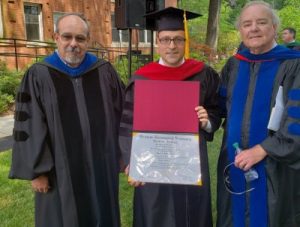 John G. Panagiotou became the first Orthodox Christian theologian to receive a doctorate at Erskine Theological Seminary on May 4, 2019, in it’s 182 year history. Dr. Panagiotou resides in Charleston, South Carolina, and his doctoral dissertation is titled “The Path to Oikonomia with Jesus Christ as Our Lighthouse: A Study in the Theology of Christian Stewardship.”