Deprecated: Creation of dynamic property WP_Object_Cache::$global_prefix is deprecated in /home/aoiusa/public_html/wp-content/object-cache.php on line 468

Deprecated: Creation of dynamic property WP_Object_Cache::$blog_prefix is deprecated in /home/aoiusa/public_html/wp-content/object-cache.php on line 469

Deprecated: Creation of dynamic property WP_Object_Cache::$cache_hits is deprecated in /home/aoiusa/public_html/wp-content/object-cache.php on line 475

Deprecated: Creation of dynamic property WP_Object_Cache::$cache_misses is deprecated in /home/aoiusa/public_html/wp-content/object-cache.php on line 476
The Stormy Petrel of the Cloth – AOI – The American Orthodox Institute – USA

The Stormy Petrel of the Cloth

Over at Orthodox History, Matthew Namee recounts the story of a bold, decisive, and courageous priest who obviously knew the full measure of his calling. He got himself into serious trouble on occassion, but only because he refused to compromise to powerful interests who, like today, subvert the faith for their own ends.

Some highlights:
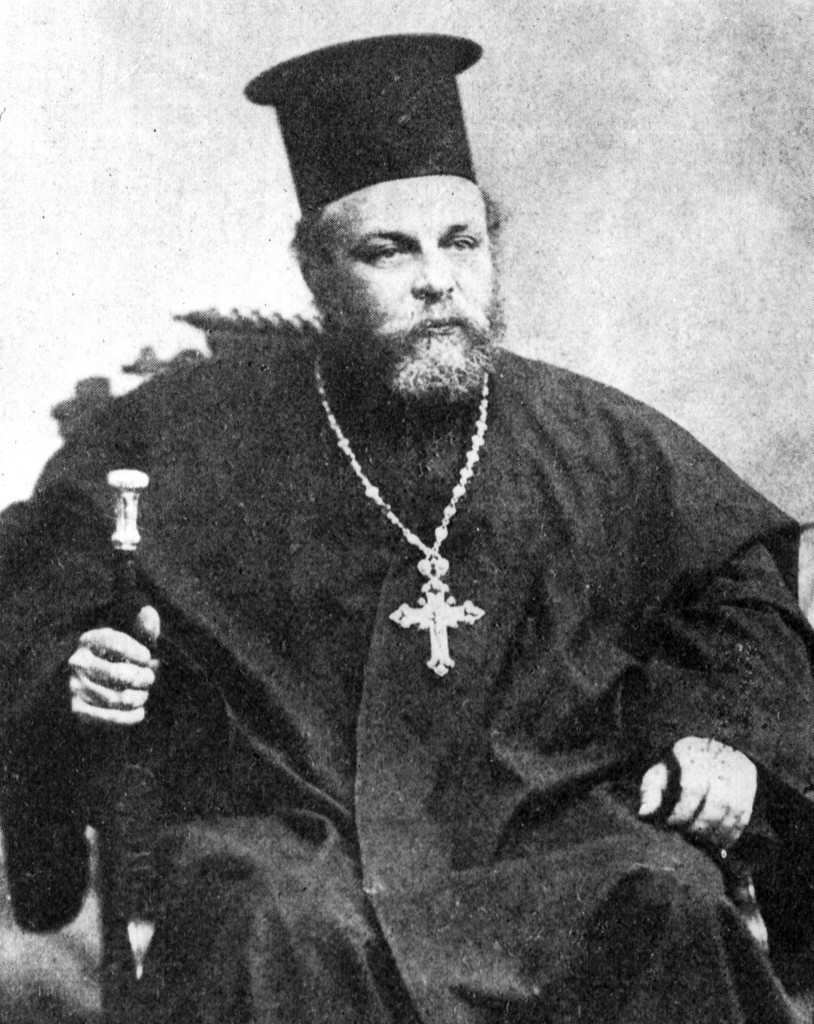
Like so many of his fellow priests, Petrides traveled throughout his region of the country, ministering to the Orthodox people he found who didn’t have a priest. One time, he went to Ithaca, New York, to do a baptism. After the service, unbeknownst to Petrides, a 16-year-old Greek girl had advertised that she would go into a “spirit trance.” Greeks had traveled from all over to witness the spectacle. Petrides caught wind of what was going on, and he burst into the room, stopped the girl’s trance, and told the people that spiritualism is against the teachings of the Orthodox Church. This was the sort of man he was – completely unafraid to stand up for what was right, no matter what.

It was this gumption that got Petrides run out of Philadelphia. Like a lot of early Greek communities, the Philadelphia church was dominated by a rich layman — in this case, Constantine Stephano, a millionaire cigarette manufacturer. Stephano and Petrides did not get along. Things came to a head in 1912, when Stephano sent the following message to Petrides – this is almost unbelievable. It said,

Constantine Stephano commands you to appear at his office every evening at sunset and salaam low upon entering his presence. Then you are to stand erect, with folded arms, with your eyes cast downward, awaiting a word from Stephano before sitting down or otherwise changing your position. If you are not asked to be seated you are to remain in this position until Stephano leaves his office, and when he passes through the door you are to salaam low again and depart with bowed head.

Stephano was obviously trying to humiliate Petrides, and Petrides would have none of it. He responded, “I will not thus humiliate myself before this maker of cigarettes.” Now, as you all probably know, in the early twentieth century, Greek parishes in America had only a loose connection to the church authorities in Athens or Constantinople. As a practical matter, the parishes were run by all-powerful boards of trustees, which would hire and fire priests at will. Constantine Stephano arranged for Petrides to be ousted from the Philadelphia church, by the slim margin of seven votes.

Read the full story at OrthodoxHistory.org.


Posted

in

by

Comments

8 responses to “The Stormy Petrel of the Cloth”

  1. John Panos

    I think the more things change, the more they remain the same. Many GOA parishes are not far from this – and for that matter, OCA and Antiochian parishes too.

    God send us bold priests BACKED UP BY bishops with enough spine to stay out of their way.

    1. George Michalopulos

      John, one way to do this would be to ordain more real monks as bishops. And let them continue to live in their monasteries, honoring their vows of poverty. You can’t threaten a true monk.

  2. Geo Michalopulos

    Now THIS was a priest! Going off on a tangent here, this story and the commentary attached to it, appears to settle the case once and for all whether the ethnic jurisdictions were canonical in any meaningful sense of the word. I particular have taken umbrage at the position that because they received antimins that they were “under the care” of Athens or C’pole. Clearly, what we are discovering is that the letter of the law was being followed (if that) and most definitely not the spirit.

    Contrast this with the Russian diocese established here in America.

  3. Chrys

    A true pastor! Thanks for the link. It was inspiring to read of Fr. Petrides’ fidelity – especially given the cost he paid for it. The linked article, however, makes no comment about the Bishop; one can only wonder where he was in all of this. What the article does make clear is that the trustees of the church had the real power and authority.

    As the article and the excellent doctoral dissertion of Fr. Nicholas Ferencz both make clear, our parishes were largely built by, paid for and ruled by a handful of influential parishioners. Add to that a long history of financial mismanagement by even well-intentioned leadership, and the result is our current situation: an oddly congregationalist polity that pretends to carry on a hierarchical tradition. And that’s the best case scenario. At worst, it means that the hierarchy is either irrelevant or compliant so that the church is effectively run by a few wealthy donors.

    Unfortunately, this problem has not been resolved. The Big Money guys in each parish still know very well that the parish depends on their contributions and, without considerable formation, this will invariably lead to a host of spiritually undesirable consequences – for the donor, the parish and the message of the gospel in that area. This would be like the Apostles letting the wealthy Joseph of Arimathea dictate the shape of their mission. (Of course, such a group wouldn’t have commanded the noble Joseph of Arimathea’s loyalty. What does that tell you about the kind of people that certain practices attract and the kind of people you don’t? Priceless integrity appeals to those who would advance the mission of the Church and bring glory to God – and it would do so for generations.)

    The present “deal” with the Big Money donors isn’t as fruitful as many seem to think. This story is a terrific object lesson. Here there was no counter-acting force, no hierarchical authority, to check and humble a wealthy layman who was apparently full of himself. What really came from this? It was more than a moment of “martyrdom” for a worthy priest. It is worth repeating: the acquiescence of the leadership is very dangerous for the wealthy malefactor (who was rewarded for this efforts and reinforced in his pride), the innocent parishioners (what awful lessons must they have taken from this?), the priest (who then knew he was on his own), and the spread of the gospel in the area (which presumably fell to other parishes . . . assuming they took up the calling). God regularly brings good from evil, but one could wish the Church offered fewer opportunities for Him to do so. As I have noted elsewhere, I expect that America’s eventual contribution to the Orthodox Church will come in the area of management and accountability.

    To avoid the travesty that occurred in the parish in the article, it is essential to have an authority – a bishop – who can and will stand up for the faith, impose discipline and back up the priest. Whatever short-term loss they would suffer in financial support (and the cost would likely be meaningful), the long-term gain in spiritual vitality would more than make up for it.

    1. George Michalopulos

      Chrys, your point is well-taken. My point on the other hand is that the extra-canonical jurisdictions which implanted themselves solely through immigration suffered tremendously under this yoke. Not wanting to belabor the point, the idea that “evangelism” and “missionary activity” was taking place in America solely on the basis of priests being given antiminsions from a bishop 4,000 miles away when viewed in light of the reality on the ground, shows the illegitimacy of this argument. This story about Petrides is just one of many. The brings up yet another even more troubling question: for every Petrides who stood up for the faith, how many buckled?

      1. George Michalopulos

        P.S. Chrys, the other point is that there was no bishop to protect Petrides. There was no bishop because Petrides pastored extra-canonical parishes set up in an archdiocese that belonged to the Russian Orthodox Church.

    2. Chrys

      George, you raise good points all. So you know, I didn’t see your post prior to posting my own comment (owing, no doubt, to the length of my comments). I read your initial comments with interest after submitting my own. At this point I can only agree with both the initial and subsequent points. While I deeply value the depth, treasures and living connections that those oversees relationships can provide, the administrative problems, diffused focus, and different political interests are all problematic, as you point out. The lack of good order (as noted in 3.1.1.) is simply a scandal.

  4. Fr. Johannes Jacobse

    Here’s the irony Chrys, and one that weak bishops don’t realize. When the Gospel is preached, the sick comforted, the youth instructed, and all the other mandates that constitute a healthy parish, the parish grows. The money necessary to run it follows with it. It’s fear that causes the acquiescence to men who use their wealth as a club.

    Further, many of the good people in parishes with these problems don’t have the stomach for the conflict that any correction necessarily causes, and appropriately so. That job falls to the priest who, as you say, must have the backing of the bishop. Where bishops back their priests (and some do), the parish ends up healthier and flourishes. Where they don’t, the good parishioners are scandalized, usually by the mistreatment of the priest, and the parish flounders, often for a decade or more.

Leave a Reply to Fr. Johannes Jacobse Cancel reply

Your email address will not be published. Required fields are marked *


Notice: ob_end_flush(): Failed to send buffer of zlib output compression (0) in /home/aoiusa/public_html/wp-includes/functions.php on line 5481