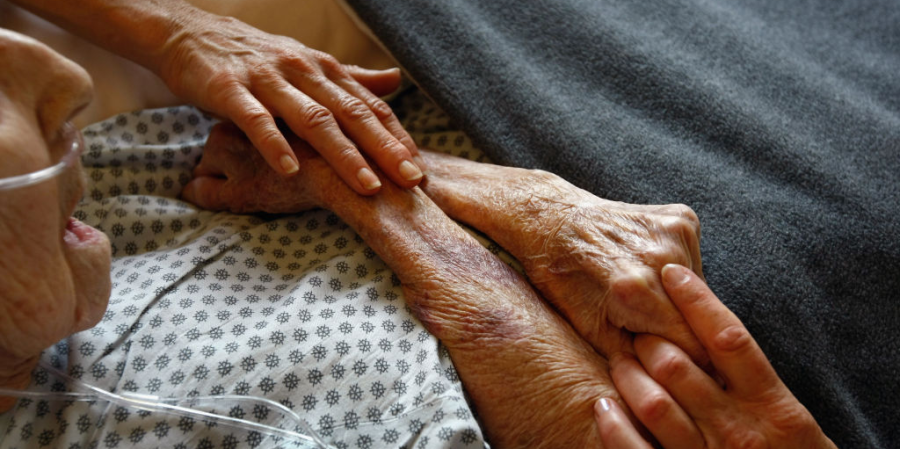
I was waiting for this. A couple of years ago I passed a hospice facility in Naples and it occurred to me that the only thing that keeps it a place where people in the stage of dying preserve their intrinsic human dignity is the attitude of their care-givers. The commitment and qualifications of the hospice workers to the dignity of their patients is what makes the hospice a place of light and comfort for them and their families in often very difficult circumstances.
But what happens if the attitude changes? What happens if the State intervenes with such things as Obamacare which inevitability will be poorly run and thus force a utilitarian calculus on end of life decisions? Will there be pressure to convert the hospice facilities to places where we hasten the death of the sick? All it would take is a change of attitude, a jettisoning of the respect for the inherent dignity of life into the perverted but increasing prevalent notion that the best way to deal with the dying is to hasten their death.
It looks as if the assault on the hospice philosophy has begun. Wesley Smith in the most recent issue of First Things writes about it below.

Hospice is about living, not dying. More precisely, hospice supports life with dignity for its patients and offers invaluable social and emotional support for patients’ families.
The foundational moral values of hospice are antithetical to everything the assisted-suicide movement represents. Hospice was founded by the great medical humanitarian Dame Cicely Saunders in the late 1960s as a reform movement to bring the care of the dying out of isolated hospitals and into patients’ homes or non-institutional local care facilities. As Saunders told me in a 1998 interview, “I realized that we needed not only better pain control [in the care of the dying] but better overall care. People needed the space to be themselves. I coined the term ‘total pain’ from my understanding that dying people have physical, spiritual, psychological, and social pain that must be treated.”
[…]
Hospice was once popular in the media. Now, assisted suicide gets most of the attention—as evidenced by the Brittany Maynard feeding frenzy. Indeed, editorials favoring assisted suicide often ignore the tremendous good hospice provides or even damn the sector with the faintest of praise.
But the attention and praise assisted suicide currently enjoys can be turned in favor of its opposite. The false meme that suicide is somehow “dignified” is an opening for the hospice movement to educate the public about what it offers the dying and their families. It is an opportunity to contrast hospice’s true compassion for those who suffer with assisted suicide’s method of patient “care”: eliminating the sufferer as a means of ending his suffering. As palliative care expert (and self-described political progressive) Dr. Ira Byock recently wrote in the Los Angeles Times, “deliberately ending the lives of ill people represents a socially erosive response to basic human needs.” No kidding. He urges instead the passage of the “Safe Dying Act,” which would step up our commitment to caring for the dying through better medical training and improved regulation, including freeing patients from the requirement that they choose between continuing treatment and entering hospice.
[…]
Read the entire article on the First Things website.
Leave a Reply to E. Nicole Cooper MD Cancel reply