Deprecated: Creation of dynamic property WP_Object_Cache::$global_prefix is deprecated in /home/aoiusa/public_html/wp-content/object-cache.php on line 468

Deprecated: Creation of dynamic property WP_Object_Cache::$blog_prefix is deprecated in /home/aoiusa/public_html/wp-content/object-cache.php on line 469

Deprecated: Creation of dynamic property WP_Object_Cache::$cache_hits is deprecated in /home/aoiusa/public_html/wp-content/object-cache.php on line 475

Deprecated: Creation of dynamic property WP_Object_Cache::$cache_misses is deprecated in /home/aoiusa/public_html/wp-content/object-cache.php on line 476
Some Thoughts on Atheism – AOI – The American Orthodox Institute – USA

Some Thoughts on Atheism

I wrote this as a comment below but it just might qualify as essay material so I have included it here as well.

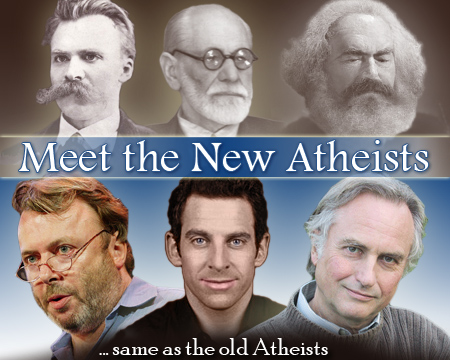
Meet the new atheistsDarwinian evolution (a process of linear development) would not have been conceptually possible in the pagan world because the notion of linear time and thus progress, require Christian philosophical presuppositions. This notion entered the world through Genesis, the narrative that portrays time and space as created, rather than eternal entities. This radical break from paganism, to which the entire world was subject until Christ entered the world, was difficult even for Christians to fully comprehend at first (Origen for example, despite his brilliance, could never shake the notion of circular time), and it would be many centuries later before the full power (freedom really) of these concepts would bear fruit. The scientific system in other words, could not have developed anywhere except in a Christian culture.

Darwin was a philosophical materialist. His theory (randomness in particular) is wholly dependent on philosophical materialism. I approach the Christian – atheist debate in terms of the history of ideas (I have to leave the science to others). Freud fell, Marx fell, and I believe that the Darwinian collapse is inevitable as well. Taking a long view it might be that Dawkins, Hitchens, and the other radical atheists represent little more than the last gasps of a dying philosophy.

My theory doesn’t speak to the ardency of the atheist of course. Their unquestioned faith in the power of their own logical processes leaves little room for any challenge from the outside. Nevertheless, atheism as we understand it today is wholly dependent on Christian presuppositions. Atheism can only arise in a Christian culture. It’s a conceptual impossibility anywhere else. Atheism presumes monotheism. Christianity is the source of both the logical concepts the atheist uses to deny it and the moral concepts and vocabulary he uses to discredit it.

Furthermore, a rejection of God, of the transcendent, does not portend a return to paganism. That, I think, is a historical impossibility because the light that came into the world by Christ, is real light. Christ in not a concept, an organizing principle, the unmoved mover of Aristotle or the great designer of Plato (as prescient as some of those concepts were), but the one through whom Creation is reconstituted in space and time. The birth, death, resurrection of Christ is an incontrovertible brute fact the ramifications of which are evident if one has eyes to see. Further, the denial or rejection of this thesis doesn’t change negate the fact; it merely leaves nihilism as the last remaining option.

The atheist disputes this. He sees atheism as a road to enlightenment. But here too we see the notion of moral and material progress, albeit temporalized. The atheist moves forward thinking that eschewing all things non-material is progress; that the process of reason alone is sufficient to find the meaning and purpose of all things. Again, it’s a conceptual framework wholly dependent on the Christianity it denies. Lacking sufficiency to fulfill this hope of enlightenment however, it will in the end either be abandoned or directed into a will to power. Those are the only two possibilities. We have seen the horror of the latter in the last century and discussed this before.

I would not be surprised to see some of the atheists embrace Islam in the end if, God forbid, the West collapses and we are forced to choose between slavery or Muhammad. There is congruency between the Muslim notion of a static god (processes and actions are a direct reflection of Allah’s will, no mediating and thus personal agent exists) and the atheist notion of an impersonal universe. Sometimes I wonder, using the biblical imagery (I believe the Jewish/Christian scriptures are the foundational and primordial narrative), if Islam is not the Assyria of the North to us Westerners. Assyria found no favor with God but yet was an instrument of His will; necessary to clarify Israel’s vision and bring them back to the one thing needful. Israel went into bondage. I hope we can avoid that fate.


Posted

in

by

Tags:

Comments

52 responses to “Some Thoughts on Atheism”

  1. Michael Bauman

    Fr. Hans, I wonder if there might be a third possibility besides abandonment of atheism or channeling it into the nihilistic will to power? The seduction of a quiet almost depressive state with the activity of the mind as the only source of light (much like Plato’s cave) is quite real. What would develope would be a kind of somnambulent slavery that seeks nothing beyond itself–a world that has abandoned any hope for salvation or any sense of its need (the will to power is a counterfeit salvation afterall). Technocratic scientism would rule and might even create a situation in which everyone is quite comfortable in their delusion. That is the world I see Robin pointing toward in his posts on the Debate thread.

  2. Fr. Johannes Jacobse

    Sounds like soma-pills (is that what they were called?). I don’t know if people can bear that kind of despair. It seems to me that would lead to even more mindless hedonism than we have today.

    1. Michael Bauman

      Father, it wouldn’t be recognized as despair and it would be born more like a dull, deep ache of uncertain origin and no remedy. Just the way we are.

      As we become more depersonalized and atomized the depressive state becomes more socially and personally useful. Hedonism will be an outlet for some, acquiring power and wealth an outlet for others, but the herd need not know or care that it is a herd, nor does nihlism have to be bloody.

      There are two things that can blow it all apart: The Cross and the hubris of Satan (he can’t stand being in the background. Sooner or later he will have to reveal himself).

      The fact that God took on His creation means there is an inexorable movement toward Him. Despite the Cross, some will resist and deny Him, but He too will be revealed even to the most obtuse and closed.

  3. Scott Pennington

    “The fool says in his heart, ‘There is no God’”. Psalm 13:1 (Orthodox numbering)

    Atheism predates Christianity considerably and in fact is implicit in the old Roman saying that, “All gods are equally true, equally false and equally useful.” In fact, one of the modern schools of Judaism, Reconstructionist Judaism, is predicated on atheism. Mordechai Kaplan, its founder, was essentially an athiest who redefined god as the spirit of the Jewish people.

    Generally, I think it is more instructive to examine the motivations of those who say they do or do not believe in God. I’m sure there are atheist, materialists who have fairly conservative sensibilities otherwise; however, I have noticed that many of those who take the trouble to describe themselves as “atheists” and actually perpetually challenge the idea of God are those who despise the morality of the traditional monotheistic religions. If one’s socio-political sensibilities are at odds with monotheistic moral tradition, one can either ignore religion, make war on it, or apostacize from it by redefining it to suit progressive sensibilities (like the Episcopal Church).

    1. Fr. Johannes Jacobse

      Atheism predates Christianity considerably and in fact is implicit in the old Roman saying that, “All gods are equally true, equally false and equally useful.”

      That’s not atheism. Atheism denies the existence of any deity whatsoever.

      1. Scott Pennington

        Yes it is atheism. If a person posits the idea that gods are only projections without any independent reality, he is an atheist. He doesn’t really believe in any god and, thus, he believes in no god.

        1. Scott Pennington

          Moreover, Buddhism in its original form, while not explicitly denying the existence of gods, was very quasi-atheistic in its rejection of their significance. A god, if it existed, was just another being succeptible to the law of rebirth and suffering, like man, due to desire. Now, Mahayana Buddhism and Lamaism came later, but Theravada Buddhism (the oldest school) taught that salvation lies within and is independent of any outside individual, “divine” or not.

  4. Scott Pennington

    I am confused about something. I see a lot of time wasted here challenging Darwinism. If the consensus here is really that the Earth is 6-8000 years old, then that’s one thing. Or if the consensus is that man was created in a manner independent of the general process of the evolution of species (not all the particulars of Darwinism), then that’s something as well. I am an Orthodox Christian. I do not believe that there is anything at all contradictory between science telling us that the Earth is billions of years old and the Genesis account. I also do not believe there is anything at all contradictory between science telling us that man evolved from lower primates and the Genesis account. Days are not always 24 hour periods and language is geared to the capacity of the hearer. God could have told the ancient Israelites to be more humane. He led Buddhists and Jainists to be more humane in a pagan environment long before Christ was born. However, absent revealing to them the insights of modern science, He could not have expected them to understand how He created everything in explicit detail. I do not constrain God in His methods of creation. I just believe that it was all done by His design and command.

    Now, it’s fine to challenge this or that aspect of Darwinism, especially the notion of randomness in evolution or the absence of God as the Director. However, if we’re really challenging the basic sketch of the physical process then I think we will inevitably look like utter fools. Evolutionary theory is quite predictive of biological mutations and development in the short term. It’s details and source might be in question, but unless we want to sound like Bible Believing Baptists who think that men frolicked in the autumn mist with dinosaurs, we should be careful in what we presume to challenge. Marx may have fallen but Darwin will forever be remembered as someone whose insights are invaluable. Whether his cosmology was accurate is another question,

    1. Eliot Ryan

      Scott:

      I also do not believe there is anything at all contradictory between science telling us that man evolved from lower primates and the Genesis account.

      Really ? What does it mean that man is made in the image of God?
      (emphasis added)

      On the last day of creation, God said, “Let us make man in our image, in our likeness” (Genesis 1:26). Thus, He finished His work with a “personal touch.” God formed man from the dust and gave him life by sharing His own breath (Genesis 2:7). Accordingly, man is unique among all God’s creations, having both a material body and an immaterial soul/spirit.
      It sets man apart from the animal world, fits him for the dominion God intended him to have over the earth (Genesis 1:28), and enables him to commune with his Maker. It is a likeness mentally, morally, and socially.

      1. Scott Pennington

        Eliot,

        If you believe that man was created in the physical image of God; i.e., that God has a physical body (setting aside for the moment God the Son in His incarnate Body) and we resemble Him physically (as some sects allege), then I see your point. But given the fact that man is a profoundly more developed intellectual being than any other primate, it does not seem odd to me that God could accomplish the creation of a being in His own Image through evolution. I suppose it is possible that God created all other life, including apes, and then decided to give man a body that very much resembled that of higher primates without causing him to evolve from them. I think that that is what you’re really suggesting. That he made physical prototypes more closely resembling man that any other animal and then, breaking the chain, created man independently from dead earth. That is a possibility, but I see no reason to insist that it is the only possibility.

    2. Michael Bauman

      Scott, what is being challenged is philosophical naturalism and its assumptions. In the opening of St. Athanasius’ “On the Incarnation” (early 4th century) he takes the time to debunk any theory that supports or comes from the idea of self-organizing matter, so its not just a ‘hick convert issue’.

      There are quite a few problems that make it next to impossible to be a faithful Orthodox Christian while accepting the tenets of philosophical naturalism. Unfortunately, theistic evolution answers none of them. Theistic evolution is a bit like the Holy Roman Empire, i.e. it is neither theistic (at least not in an incarnational Christian sense)nor evolution but pretends to be both. An early exchange between two substantial Orthodox, Dr. Kalamiros and Fr. Seraphim Rose, occured about 40 years ago. Whatever else one may think of Fr. Seraphim, describing him as a ‘Bible Believing Baptist’ would be quite a stretch.

      Here is a link: http://orthodoxinfo.com/phronema/evolution_frseraphim_kalomiros.aspx

      The academic Orthodox theologians particularly of the English school tend to support some brand of theistic evolution, but (having heard both Met. Kalistos and Fr. Louth personally on the subject) without much real thought — they just don’t want to make waves within their academic community.

      It would be quite possible, even preferable, to ignore the whole debate and simply live as the Church teaches but once the debate is joined, there does not seem to be much room for compromise.

      1. Scott Pennington

        If “divinely guided development” of earth and humanity doesn’t suffice for a person, then I have to disagree with them. The whole 6000-8000 year thing is probably indefensible. And, really, it’s a battle there is no reason to fight since a) we would be “head in the sand” wrong and b) a much longer period is compatible with Christianity.

        Also, I don’t really take issue with the notion that God engineered the world so it would develop as He willed and that He engineered the development of life so that it would end in a creature created (by a long process) in His Image. “Self-organizing matter” is programmed by its Creator to behave in certain ways, i.e., it is not “self-organizing” if you believe in a Creator. Also, not only could He control its development through setting it in motion according to certain laws, but He could direct its development however He willed at any given point. Trying to discover laws of evolution, for a theist, is trying to uncover the basic pattern of God’s development for His handiwork. That He might digress at times is certainly possible, but it may be scientifically valuable to know the default trajectory He has set in place.

        1. Scott:

          The whole 6000-8000 year thing is probably indefensible. And, really, it’s a battle there is no reason to fight since a) we would be “head in the sand” wrong and b) a much longer period is compatible with Christianity.

          Indeed.

  5. Fr. Johannes Jacobse

    Darwinian cosmology is what we are talking about here, not science as such. Many scientists in fact are arguing that the Darwinian cosmology restricts the advance of science, such as Berlinsky, Gilder (Evolution and Me) and others. I’ll let Nick Katich, Chris Banescu and others weigh in on this since they are better informed on the science than I am.

    1. Scott Pennington

      There is another thing that has bothered me about the Christianity alone vs. paganism narrative which has really only crystalized as a result of this discussion.

      Man was originally monotheistic. Whether one believes literally in Adam and Eve as historical persons, the fact remains that they, or early man, was monotheistic according to Christian cosmology and it was only after the fall and generations of progressive debauchery that they fell into idolatry or paganism. Thus Christ’s coming is often characterized as a kind of return to Eden, Christ being the Second Adam, the Theotokos being the Second Eve, restoring (and expanding) the original Grace of the Garden. It thus makes more sense to state that man has always been capable of rejecting paganism and embracing monotheism. He just has neglected to do it not because of cosmology but because of sin. Now sin can result in the creation of a very powerful false cosmology, I admit. But bear in mind that there have been a number of civilizations that were not really pagan in the sense of the ancient Greeks or non-Hebrew Semites or Romans, which predated Christ.

      Obviously, for starters, the Jews. Prior to the time of Christ’s arrival, they (the Pharisees at any rate) believed in “the Resurrection of the Dead and the life of the age to come.” Olam ha-ba in Hebrew means, “Age to come”. That’s how the terminology entered the Christian vocabulary. Now, the way they believed that God conquers death is through giving the Law. Jews who obeyed the Law for their righteousness were rewarded with eternal life, as well as perhaps some righteous gentiles who abided by the Noachide Laws (which, incidently are probably the laws described as applying to Gentile Christians at the Apostolic Council).

      Other ancient peoples, for instance the Parsees/Zoroastrians, also would not be best described as pagans. The Zoroastrians were/are inclined to dualism – – a belief in a God and an anti-God. But the God wins in the end. That was founded 600 years or so before Christ.

      As I discussed elsewhere, Buddhists originally were not exactly categorizable as pagans because the had a unique theory of “salvation” which avoids the existential “rock and a hard place” described by Fr. Johannes in his talk after the athiest debate.

      There is a sense in which Christian history is circular as well. We came from a state of grace where death was unknown and we return to a state of grace where death is unknown. It’s the middle part which, like in Judaism, is intensely linear.

      Judaism, Christianity and Islam (being the largest monotheistic religions), did collectively largely put paganism out of business. But atheism has been conceivable since very early in human history (see again Psalm 13:1).

      The language we use regarding the Death and Resurrection of Christ is interesting. We say that He “trampled down death by death, bestowing onto those in the tombs eternal life.” Now, men lived and died before Christ. And it was always in the plan for men to be resurrected from the dead (see Ezekiel), this was known from long before Christ. I think the phrase has several meanings but two of them are certainly that, having assurance of our eventual resurrection and judgment (hopefully to the side of the sheep) death has no sting for us. This is not really an innovation over Pharasaic Judaism though. The means of overcoming death was somewhat different, but the fact of it being overcome was just as certain. But it also means that following the Resurrection, not only do we have the assurance of our own resurrection from the dead, but we no longer are prevented, if we accept salvation by living a faithful life, from experience the full grace of God, the “Beautific Vision” so to speak, before the General Resurrection. We can now go to a heavenly repose. I’m not sure that was possible before the Resurrection.

      But there is also a “second death”, eternal damnation, which is the real thing we are saved from. So Christ did “trample down” sin and death. But both physical and ultimate spiritual death remain for those who do not have faith in Him. Death is not newly destroyed or abolished, except for the faithful. To claim otherwise is to claim Universalism. We continue to die, faithful or not, just as before Christ. And we will be resurrected and judged, faithful and unfaithful, just as was known to the Pharisees before Christ. And some will be blessed and some damned, just as was known before Christ as well as after. The real difference is in the means of salvation.

      There were never any other possibilities, even according to Pharasaic Judaism.

      1. Michael Bauman

        Evolution, even the so-called theistic kind is essentially chiliastic in rejecting both the incarnation and the need for salvation through the incarnation. The theistic type also has a decidedly dualistic tenor.

        1. Scott Pennington

          Michael,

          The problem is that the basic idea behind it, it terms of its physical manifestations, is objectively verifiable. So, if it truly is completely incompatible with Christianity, then Christianity is a false religion. It’s really that simple.

          In a sense, and this is an exaggeration admittedly, it’s like rejecting the law of gravity because it impinges on the sovereignity of God. But gravity is verifiably in effect. I do not dispute that gravity is a creation of God, or that He could suspend it to whatever ends that He wishes, just that it exists. The basic idea behind evolution is the same type of deal. We have fossil records and carbon dating. Our observance of the stars and measurement of the speed of light and red shift tell a compelling story of a very old universe and a long road of human development. The theory is indispensible in explaining short term mutations and other short term, verifiable, biological phenomena.

          It is one thing not to base ones faith on materiality alone. It is a very different thing to reject the evidence of the material universe in favor of something that is contradicted by observation. Especially when it’s not essential to the Christian faith.

          I’m not interested in being an ostrich.

          1. Michael Bauman

            Except that the macro evoloution (species change from the lower to the higher, the more complex from the less complex) proclaimed and celebrated by the evolutionists is not a demonstratable fact verified by observation. It is purported evidence within a interpretative matrix that assumes a not God. In fact from the beginning the quest for a ‘scientific explanation of orgins’ was motivated by a desire to exclude God from human affairs. The popularizers have, since the very beginning, pushed evolution as a foundation for an anti-Christian morality. Some of the early evolutionary theorists made specific attempts to create a relgion in opposition to Christianity. There is no question that such attempts fed National Socialism. The modern popularizers of evolutionary philosophy retain their anti-Christian position in often virulent language (they’d just as soon see us in the loney bin). Theistic evolution attempts to throw out all of the not God assumptions and leave the reslutant interpretions of the supposed facts intact simply to keep peace with the mind of the world. That’s just crazy.

            You make the point, either one accepts the anthropological claims of evolution or of Christianity, they are not compatible. One can’t serve two masters.

            One either accepts the natualistic, bottom up mentality that confines humanity to being just another beast or the incarnational reality of Jesus Christ; a chiliastic eschatology or the Christian one. Worship of God or of the created thing.

          2. Scott Pennington

            Michael,

            I think that you pose a false dichotomy which in the end will subject you to ridicule not only by secularists (which is not a matter of concern), but by many faithful Orthodox (which might be). I do not agree with your remarks regarding macro-evolution either. First, I’m not sure that it is a matter of complexity, but adaptation to conditions. However, you can see a general tendency to more advanced life forms over the millenia. I don’t suggest the fossil record is complete, but you would not expect it to be so.

            Also, you are incorrect in your conclusions. Subscribing to the underlying notion behind evolution does not make man into “just another beast”, but the crown of God’s creation, created in His (intellectual) Image, whom God saves by becoming one of. It is only if you posit a situation, which I don’t, in which God gives infinite reign to laws He has set in place that you come to that conclusion. However, scripture is clear that man is God’s highest creation and that He will come again and end the world as we know it.

            As far as your suggestions that accepting a kind of theistic evolution is “chiliastic”, I have no idea what you are talking about. I understand how the term describes some early heresies and certain forms of Protestantism, but no one here is positing a thousand year period where Christ reigns on Earth, followed by a rebellion and second epoch. You simply can’t get that from the bare assertion of “theistic evolution”. Now, the notion that man is headed for a Golden Age or long period of happiness is something that you could posit if you wished, but it has nothing whatsoever to do with the underlying theory. You seem to want to believe that the theory is somehow in control if you accept the fact that it explains the past. I do not make this unwarranted assumption. I think what you seem to want to believe is that “theistic evolution” inevitably leads to notions of a “thousand year Reich”. I don’t think that is any more true than the notion that creationism necessarily leads to female circumcision.

            It is entirely possible that God ordered reality in such a way that animals evolved over millions of years to the point of producing hominids and then, breaking with that line of development, God created out of raw earth a man. I do not discount that possibility. However, the truth of Christianity simply does not depend on it. The difference between you and me, Michael, is that if the underlying idea behind evolution is true, then your religion is dead. Whether it is true or false, mine lives.

          3. Scott:

            It is one thing not to base ones faith on materiality alone. It is a very different thing to reject the evidence of the material universe in favor of something that is contradicted by observation. Especially when it’s not essential to the Christian faith.

            I once gave a young-earth creationist pause putting it something like this: Shouldn’t the testimony of stones authored directly by God have more weight than calculations from Bible genealogies transcribed by falliable humans?

          4. Scott Pennington

            Robin,

            I do get the feeling that the creationist strain in Christianity will not be happy until they have created their own little Amish like cult, devoid of any plausible relevance to the rest of humanity. Well, it’s a free country.

  6. Dean Calvert

    I sure hope you all saw the Steve Martin You tube “

    Atheists Don’t Have No Songs

    It’s a riot!

    best regards,
    dean

    1. Hi, Dean. I did see and enjoy that video. Though of course we do have songs, frex,
      John Lennon’s “Imagine”,
      George Gershwin’s “It Ain’t Necessarily So”,
      Crash Test Dummies’ “God Shuffled His Feet”,
      Larry Gallagher’s “I Am Better Than Your God”,
      Tool’s “Opiate”, and
      XTC’s “Dear God”.

      (I don’t know how to embed YouTube players in comments like you do.)

    2. Huh, so links to MP3s turn into audio players? That plays a clip of Larry Gallagher’s “I Am Better Than Your God”.

  7. Eliot Ryan

    Scott:

    I think that you pose a false dichotomy which in the end will subject you to ridicule not only by secularists (which is not a matter of concern), but by many faithful Orthodox (which might be).

    I believe you are saying that God cannot be that all-powerful to create all animals as described in the Bible. He needed some extra time.
    Evolutionism is a narrative, fancily decorated with scientific terms; a mere hypothesis based on no evidence. It is based on hand-drawn cartoons or animation, fraud and clever forgery (ex: Piltdown Man went from being one of the biggest discoveries of the 20th Century to being its greatest scientific embarrassment) which fooled the world’s best experts for a long time. Missing links (ex: “Nebraska Man”) were built from one tooth or from bone fragments plus an extra ingredient: imagination!

    1. Scott Pennington

      Oh, Eliot!,

      You might just as well say that you do not think God is powerful enough to create a mankind that chooses consistently not to sin. As to the rest of it, it’s getting boring.

      Scott

      1. Eliot Ryan

        Scott: Theistic evolution is the ‘gray’ area, open to anyone, which should not be used unless it is absolutely needed. There is no room for a gray area in Truth. The sinful man is still created (did not evolve from animals) and having free will. I wonder at our free will: we have the freedom to choose evil, the cause of all misery and we have the freedom to become saints by clinging to Christ and by throwing off the chains of sin. “God is glorious in His Saints”. Blessed be the memory of the righteous ones who stood firm.

        1. Scott Pennington

          “There is no room for a gray area in Truth.”

          Spoken like a true ideologue. What is a theologumenon other than a “gray area”?

          1. Eliot Ryan

            Scott:

            Spoken like a true ideologue. What is a theologumenon other than a “gray area”?

            A theologumenon is a theological statement within the Christian theology, which does not represent or is not a part of the obligatory faith statement or faith truth (dogma), but is nevertheless regarded as important content-wise as part of the faith.

            We do not know for sure if the six days of Creation were literally six twenty-four hour periods. We have some reference points though: sick people were instantly healed and Lazarus’s decomposing body came back to life at Christ’s word. In a way, the Book of Genesis resembles evolutionary theories: creation started from from plants to animals to men. Man is the crown of creation because he is made ‘in our image, after our likeness’ (Gen. 1, 26). The many resemblances between the human body and the bodies of the higher animals are used to prove the atheist evolutionists claim. This led directly to the anti-spiritual (anti-Christian) concept that man had no Creator-God, neither immortal soul. These resemblances are rather proof of the existence of a Creator who designed both the human body and the bodies of animals.

          2. Scott Pennington

            Eliot,

            A theolegoumenon is a pious opinion held by some but not all Orthodox which does not enjoy catholicity and therefore which no one is bound to accept; i.e. it is one of those gray errors that you seem to detest.

            I do not dispute that the theory of evolution has been used to beat up on Christianity. I also do not dispute that if it is understood in such a way as to eliminate God as the origin of all material activity, then it is mistaken to that extent. However, apart from that, the underlying idea behind it is probably true. And if it should be confirmed more certainly in years to come, those of you who reject it out of hand and say that it is mutually exclusive with Christianity will, in effect, have your religion proven false.

            I see no reason to dig myself a hole. If you’re certain it’s false, fine. I’m not.

            As to “days”, if you read Fr. Seraphim Slobodskoy’s book, The Law of God, which is the most common catechism in the Russian Orthodox Church Outside Russia (hardly modernists), you will see that the author has no problem with “days” meaning “eras”. The term is used flexibly in Scripture and in the Fathers, according to him. That would put you pretty far out of the mainstream if you are taking issue with that.

            Why would God create lower hominids that very closely resemble man,even seeming to be evolving in a line that ends in man? Why would God create the world in such a way that we can discover a way to date fossils and the Earth itself and plant false evidence which would lead us to grossly overestimate the ages? Is He more like a mischevious Pan who wishes to trick us into believing something contrary to Scripture?

            I don’t think so. Believe what you will. I’m tired of beating this dead horse.

  8. Oh, you started a new topic. I’ll reprise my comments from the other thread, then.

    Fr. Jacobse:

    The scientific system in other words, could not have developed anywhere except in a Christian culture.

    No, the roots of the scientific method were developed by the ancient Greeks, and refined by medieval Muslims.

    Darwin was a philosophical materialist. His theory (randomness in particular) is wholly dependent on philosophical materialism.

    Darwin’s theory works and makes correct predictions, and would continue to do so even if materialism were not true.

    Taking a long view it might be that Dawkins, Hitchens, and the other radical atheists represent little more than the last gasps of a dying philosophy.

    Seems unlikely when surveys in Western nations show atheism on the rise and major religions shrinking.

    In recent news, Great Britain is now a majority nonreligious nation. According to the British Social Attitudes survey’s 2010 result published last month, Brits now are 42% Christians and 51% no religion. When they started taking this survey in 1985, Brits was 63% Christian and 34% no religion. Quite a turnaround for one generation.

    According to the American Religious Identification Survey’s 2008 results, Christianity is dwindling in the USA by about 0.6% a year (from 86% in 1990 to 76% in 2008), and “None” is the fastest growing religious category (from 8.2% in 1990 to 15.0% in 2008).

    Perhaps your anti-atheist fearmongering represents a backlash against shrinking religiosity by a declining religion.

    I believe that the Darwinian collapse is inevitable as well.

    You believe a lot of ridiculous things, including such obvious falsehoods like “Almost all (thinking) atheists are Marxists”, “Naziism… was merely atheism in Teutonic dress”, and this:

    Atheism can only arise in a Christian culture. It’s a conceptual impossibility anywhere else. Atheism presumes monotheism.

    The word “atheism” originated in a polytheist culture; it derives from ancient Greek ἄθεος (atheos). The term referred specifically to those who rejected their pantheon of gods.

    To ancient Greeks (and subsequently to ancient Romans), Christians were “atheists”. Hellenists and Christians both used the Greek term, pejoratively, to describe each other. Its meaning narrowed over time to mean one who disbelieves in not just the speaker’s gods, but all gods.

    Atheism itself long predates Greece, however. It predates the oldest living religion in the world, the Aboriginal Dreamtime religion, which has lasted for 47,000 years. Atheism goes back to the dawn of humanity. Before prehistoric cave dwellers first invented deities, everyone was an atheist, they just had no need for the concept.

    The atheist disputes this. He sees atheism as a road to enlightenment.

    Building straw atheists to argue with again, I see.

    The atheist moves forward thinking that eschewing all things non-material is progress; that the process of reason alone is sufficient to find the meaning and purpose of all things.

    Counterexample: Some atheistic Buddhists believe in karma and reincarnation, which isn’t “eschewing all things non-material”. Not all atheists are materialists. And materialists have no need to “shun” that which doesn’t exist.

    From my point of view, there’s no extrinsic meaning or purpose to all things. So one might say our purpose is to make our own purpose for being.

    Again, it’s a conceptual framework wholly dependent on the Christianity it denies.

    The ancient Greeks didn’t need Christianity to come up with it.

    I would not be surprised to see some of the atheists embrace Islam in the end if, God forbid, the West collapses and we are forced to choose between slavery or Muhammad.

    Anti-atheist and anti-Muslim, it’s a fearmongering twofer!

    If my only choices were slavery or Muhammad, I’d do what many atheists in Islamic theocracies have to do, be a closeted atheist and publically pretend to accept Islam.

  9. Geo Michalopulos

    Robin, you’re quite wrong about the Greeks and science and definitely about the Muslims. Science in ancient Greece was very anti-empirical and the idea of Occam’s razor almost non-existent. As brilliant as science was in the Muslim world, it was only because they took over Christian cultures who were already on a scientific trajectory. The earliest Arabic treatises on Aristotle and Ptolemy for example were translated by Assyrian priests into Arabic. The Arabs merely expropriated the learning of their subjugated peoples.

    As for the scientific method per se, it only arose in the West and in a Christian milieu. Once Augustine took the quasi-neo-platonic concept of the divine Logos and ran with it, then empirical reasoning and outright physical experimentation (which the Greeks disdained), took off. Especially in the High Middle Ages among the Franciscans. In no where else in the Medieval world (Byzantium even) did the scientific method arise. In fact, modern science could not take off until Paracelsus burned all of the writings of ancient Greeks. Sweet irony: it wasn’t the Church which burned the books of the ancients but the father of anatomy.

    Your historical knowledge is quite insufficient.

  10. Maxim

    Robin, if i’m not mistaken, i believe Fr. Johannes is referring to “post-entlightenment” atheism. Scott, all truth claims require faith. I don’t believe i have enough faith to believe the truth claims you are making about evolution.

    1. Maxim claims “all truth claims require faith”. Not true.

      For a simple example, I claim 1+1=2. I don’t need faith to make that claim, and you don’t need faith to accept it.

      1. Michael Bauman

        Yes you do. You have to have faith that 1 is a unique whole integer and that the combination of two such unproveable things will always equal another unique whole interger. It is just that the faith is so deeply inculcated into us that we no longer recognize our acceptance of the underlying assumptions as faith.

        1. I don’t take it on faith that the sum of two integers is another integer.

          My math teacher didn’t just say “The sum of two integers is another integer, and you’ll just have to take my word for that.” I learned sums by doing them. (Didn’t you?) Because I understand how addition works, I know two numbers with no fractional part, when combined, will still have no fractional part. Furthermore, every sum of whole numbers I have done in my entire life evidences this fact.

          As a rule, I don’t take anything on faith. I aspire to let the winds of evidence blow me about like a leaf, and go wherever it takes me.

  11. Harry Coin

    A view from the perspective of ‘the results anybody from anywhere who measures will get again and again’ to frame what’s important and lasting about Darwin’s views and I think not in conflict with ‘creationism’ or ‘There is no God’ presuppositions goes something like this:

    Let’s look carefully and attempt to roughly assess the number of the possible outcomes of any two living things surviving long enough to reproduce. Plainly the number is countable since the number of living things is countable though nobody could actually pull off doing the counting. Then look at all the possibilities of the physical circumstances involved that might affect the results of the reproductive effort. Is there a level at which science itself might not be able to rule out guidance of the process unseen and perhaps even unseeable by science?

    Prior to the thinking that led to an appreciation of the things people who study quantum mechanics measure, the staggeringly large and barely comprehensible number of possible outcomes of what might happen between any two living things becomes tractable only if a person uses statistical characterizations. These sort of physical characteristics are seen in thus and such part of the historical record, to be continued in this new mode and changed in this way later, to be ended there, and so on. We get phrases like ‘survival of the fittest’ and other related.

    Recently we’ve learned about something measurable again and again yet utterly foreign to any of the thinkers in Darwin’s day: That it is possible to make a change to a physical biochemical reaction, a meaningful change in that it can make a big difference, without adding energy or removing it, and possibly from a distance, without anything measurable whatever passing between the agent making the change and the thing affected. We’ve also learned that there is no way to measure whether a particular outcome is or is not ‘random’. We can’t tell both where something small is and how fast it is going where. But we know that some life processes that lead to great genetic effect come down to which molecules happen to pass by which other molecules at just the right speed at just the right angle at just the right moment each with component parts spinning in just the right direction with valence electrons in just the right part of their complex oribital dance. Our best modern science tells us that at best we can say something statistical about the shape of that orbital dance.

    Just think about that carefully for a bit. The scientist who is true to the craft must say science is silent about that which can’t be measured in a repeatable way. It is often scientifically not possible to say whether this or that specific genetic change was or was not intentionally done by those with sufficiently sophisticated means. Whether the vanishingly improbable happened as a consequence of sufficient repetition or by the ‘unseen hand’. We find the door to faith left open by the sort of science that depends upon experiement. The other sort of science, the sort that does not rely on repeatable experiment, is called ‘politics’. Likewise the sort of faith that flies directly in the face of what experiements can repeatably demonstrate to any who do them could well be called God telling you to repent.

  12. cynthia curran

    Scott is insightful on this problem of Darwin and science. I might add neaderthal is not human in the modern sense. And sense the bible does interesting mention Ethiopia where the unknown river Gihon is mention as one of the four rivers of Eden. This is also where modern man was suppose to eventually come out of. Also, most of Eden is located also in the old Mestoptamia region and might be in the Persian Gulf below this or an old land mass of the Persian Gulf, there are a lot of theories. But the Mesoptamian region is where the Summerians were located who also had similar stories to Gensis like a Garden or a tempting serpent and the flood story. So, this is pretty ancient information about this region that predates Gensis and probably shows that Ur was the home of Abraham.

  13. cynthia curran

    George, is correct that science developed in the high middle ages since the Greeks were very Speculative, and the Greeks like Hero invented the steam engine but didn’t use it for a practical application but for things like birds singing and in the Eastern Roman Empire during the middle ages Lions to roar on the imperial throne. Actually, Byzantium even developed warfare techinology compared to the Greeks and the all conquering Romans. Greek fire was some sort of Naplam.

  14. Maxim

    Amen elliot!

    We should worry less about whether we may be laughed at by secular humanists and more aboutassisting each other in our salvation.

  15. Eliot Ryan

    Scott:

    Why would God create lower hominids that very closely resemble man,even seeming to be evolving in a line that ends in man? Why would God create the world in such a way that we can discover a way to date fossils and the Earth itself and plant false evidence which would lead us to grossly overestimate the ages? Is He more like a mischevious Pan who wishes to trick us into believing something contrary to Scripture?

    I don’t think so. Believe what you will. I’m tired of beating this dead horse.

    The story of the Tower of Babel tells about the confusion of tongues. Ever heard the idea that the monkeys devolved from man? The most disobedient and arrogant were turned into monkeys. Such a claim might seem exaggerated, if not absurd, but the reverse (monkeys evolving into man) is equally absurd, yet it is the only “politically correct” version of our origin.

    Apparently you believe that the methods used to date fossils and the Earth itself are accurate.
    See: The Dating Game by David N. Menton, Ph.D.

    In this “circular dating” method, all ages are based on evolutionary assumptions about the date and order in which fossilized plants and animals are believed to have evolved.

    I am getting tired too. Let us pray, lest we perish!

  16. Scott Pennington

    “Ever heard the idea that the monkeys devolved from man?”

    Well, I believe that says it all.

    1. Eliot Ryan

      Robin:

      Well, I believe that says it all.

      What does it say? First of all, why are you taking it out of context? It was just an idea which “might seem exaggerated, if not absurd, but the reverse (monkeys evolving into man) is equally absurd”. Secondly, I can even defend the idea.
      Lucifer and all the fallen angels were once beautiful creatures. Pride and disobedience changed them into ugly creatures.
      Elder Cleopa spent ten years praying in the wilderness and he had some interesting encounters (Robin would call it “fairytales”). He says that “one devil alone is so ugly, that if he were to come here where we are now and show his face just as it is in hell, none of us will survive the horror. We would all die of such ugliness and terror at the sight of a fallen angel.”
      There is a growing number of cafeteria Christians: they pick and choose which doctrines they will (or will not) accept. We fear the risk of being laughed at by secular humanists. As a result there is a lot of confusion. A respected Hieromonk once told me: “be grateful that your priest is not an evolutionist”. If we keep going on like this, we’ll become ourselves secular humanists.

      1. Eliot Ryan

        Oops. I meant Scott.

  17. Isaac

    Eliot,

    The integrity of your faith seems to be wrapped up in evolution not being true. I would hate to add non-negotiables to the Creed like that and turn out to be wrong. Yes I am sure some people are worried about being ridiculed or mocked for believing something unpopular, but there are also people who are concerned about the truth and don’t want to deny the truth.

  18. Eliot Ryan

    Isaac:

    The integrity of your faith seems to be wrapped up in evolution not being true.

    Before taking a closer look at evolutionism and its implications I had read the lives of the Saints. Saints’ virtues and all their good deeds are copies taken from the great original – Christ. His Saints practiced hard asceticism, fasting, vigils, prayers, and virtues in general. Saints are usually reputed wonder-workers to whom great powers of prophecy, clairvoyance and healing were attributed through the ages.
    St. Innocent tells us “Every sin drives away the Holy Spirit. Most hated, however, to Him are pornic sins among the bodily ones, and pride among the spiritual ones. The Holy Spirit, the perfect purity, cannot live inside a man defiled with sins. How can He stay in our heart, when it is filled with cares, desires and passions?”

    The theory of Evolution was quickly embraced by those who regarded it as the best thing serving their own ends and wants (desires and passions). It also serves as a point of departure from the Truth toward the slippery slope leading to bottomless trap of falsehood. Nowadays there is a competition between Truth and the feeling of awed wonder that science can give us. During the 1st Ecumenical Synod of Nicaea there was a competition between Truth and rhetorical art. The truth was demonstrated back then by the miracle of St. Spyridon :

    Saint Spyridon, however, did not let them stop him, because he knew that the Wisdom from on high is superior to the human and ephemeral wisdom; he approached the Sophist, then, and said to him: «In the Name of Jesus­ Christ, note my words, philosopher, and listen to what I want to tell you!». The Sophist replied to him: «Speak and I will listen to you! ». Spyridon then said: « There is only one God, Creator of heaven and earth. He created the heavenly Powers, made man from clay and created simultaneously all things visible and invisible. It was by His Word and His Spirit that heaven and earth were created, the sea flew out, the firmament stretched out, the animals were born, man was created, the most beautiful of His creatures. All the stars were created, the sun and the moon, night, day and all the rest. We know, then, that the Word is the Son of God and God Himself. We believe that, for us, He was born of the Virgin, was crucified and buried. Then he rose and raised us with Him, granting us incorruptible and immortal life. We assert that He will come a second time to judge all people and examine our own works, words and thoughts. He is of the same essence (homoousios) as the Father, equal in dignity, and reigns with Him. Don’t you agree philosopher? », he asked him.

    We must relate here the famous miracle of the tile. After these words, the Saint took a tile in his left hand and held it tight. Moreover, for a wonder! Fire rose up immediately in the air, water poured out on the earth and the argyle of the clay remained in the hands of the Saint, symbolizing in this way the life giving and indivisible Trinity. Everybody was amazed. The philosopher did not seem to be the same person any more, to possess neither the same mind nor the same language, he that knew so well to oppose and to quarrel.

    My question is : from what St. Spyridon said, which part do you believe and which part you don’t?

  19. Scott Pennington

    “My question is : from what St. Spyridon said, which part do you believe and which part you don’t?”

    ” . . . made man from clay and created simultaneously all things visible and invisible.”

    Specifically, I for one do not believe that the making of man from clay was necessarily a direct act but could have been done over a long period of time through evolving him from clay through a chain of evolution into his final present form. Also, the saint was dead wrong when he said God created simultaneously all things visible and invisible. The Creed does not say “simultaneously” and, in fact, the Genesis account specifically says that God created things progressively, one day this, another day that.

    And, by the way, saints are not infallible.

    1. Eliot Ryan

      Scott:

      And, by the way, saints are not infallible.

      None of them ever claimed such thing. I personally tend to give more weight to their words because of their virtues and the wonders they worked. They always attributed all their miracles to Christ. It seems that there is a word “simultaneously” you have a problem with. I’ll try to find the text somewhere else to see if the word “simultaneously” is there . If you cross out the word “simultaneously” can you find anything else wrong ?

      1. Scott Pennington

        Eliot,

        It was just the way you dared Isaac to challenge the holy words of the holy man as though quoting him closed the case. I thought I’d point out that Orthodoxy has no doctrine of infallibility for the saints. Also, since he never heard of the theory of evolution, it is not too wise to rely on St. Spyridon’s words as proof that it is unchristian. Whatever else we know, we do know that he wasn’t addressing evolution. Now, if you have some statement of a modern synod disapproving of the basic idea behind the theory, that would be interesting. But, in general, I think modern Orthodox hierarchs have preferred not to address the question other than to say that God created everything, including man.

        1. Eliot Ryan

          I believe that facts which were not directly witnessed (Creation) were revealed to certain saint(s). These revelations were “gifts” similar to other gifts like powers of prophecy, clairvoyance and healing. Please notice the difference between “gift” and “knowledge”. The gift of healing does not require medical knowledge; it is the ability to call on God to heal the sick through supernatural means.
          St. Matrona did not have knowledge of architecture and she was not only blind, she didn’t even have eyes, yet she could “see” the streets and buildings in Italy:

          That afternoon Matrona listened to me attentively and said, “Don’t worry, don’t worry, you will pass your exam! Tonight, we’ll have tea and talk about it.” I could hardly wait for evening to come and when I joined her, she said, “I will go with you to Italy, to Florence, to Rome and we will see the works of the great masters.” Then she began to enumerate the streets, the buildings! She paused at one point: “Behold, the Plazzio Pitti… and here’s another palace with archways, similar to the one in your work – a building with three lower levels of massive stonework and two arched entryways.” She spoke in detail about the architectural elements of the building, and I was shocked at her knowledge of the subject. In the morning I ran to the institute, put tracing paper over my project and using brown ink I made corrections based on what she had said. The commission came at ten o’clock. They looked over my project and said, “And so, your project came out well, it looks excellent – go ahead and defend it!”

  20. Maxim

    Robin, forgive my laziness. Obviously truth claims that are visibly self evident requires no faith. It is that which is not visibly self evident that requires faith, i.e. there is no God. Faith is required to believe this claim.

    1. I also claim that 874 + 569 = 1443. That’s not visibly self-evident, but you need not accept that on faith either.

Leave a Reply to Maxim Cancel reply

Your email address will not be published. Required fields are marked *


Notice: ob_end_flush(): Failed to send buffer of zlib output compression (0) in /home/aoiusa/public_html/wp-includes/functions.php on line 5481