Deprecated: Creation of dynamic property WP_Object_Cache::$global_prefix is deprecated in /home/aoiusa/public_html/wp-content/object-cache.php on line 468

Deprecated: Creation of dynamic property WP_Object_Cache::$blog_prefix is deprecated in /home/aoiusa/public_html/wp-content/object-cache.php on line 469

Deprecated: Creation of dynamic property WP_Object_Cache::$cache_hits is deprecated in /home/aoiusa/public_html/wp-content/object-cache.php on line 475

Deprecated: Creation of dynamic property WP_Object_Cache::$cache_misses is deprecated in /home/aoiusa/public_html/wp-content/object-cache.php on line 476
Russian Church opens in Antalya Turkey (On the territory of the EP) – AOI – The American Orthodox Institute – USA

Russian Church opens in Antalya Turkey (On the territory of the EP)

This story, available only in Russian (Google and Bing translations provided below), provides a glimpse into the changing relationship between Moscow and Constantinople, one that may account for Constantinople’s recent diplomatic success with the Turkish government. For years the Ecumenical Patriarchate suffered the hardships of a beleaguered minority but in the past few years has witnessed an easing of pressure by the Turkish government. The Russian population in Turkey vastly outnumbers the Greek and the Russian Orthodox Church is clearly flexing its muscles in part because Russian – Turkish relations are largely improving. Add to this the sizeable Armenian and Catholic populations in Turkey and we may be seeing a significant shift in both the role and position of the Ecumenical Patriarch in world Orthodoxy.

HT: St. Andrew House Orthodox Forum Source: Russian Orthodox Church – Department for External Church Relations

[tab name=’ORIGINAL RUSSIAN’]

Архимандрит Виссарион (Комзиас): Открытие русского православного прихода в Анталье – это большой прорыв в отношениях как между Константинопольским и Московским Патриархатами, так и между Москвой и Анкарой

В интервью порталу «Православие и мир», опубликованном в декабре 2010 года, великий иерокирикс Константинопольского Патриархата архимандрит Виссарион (Комзиас) рассказал о жизни окормляемого им русского прихода святого Алипия Столпника в Анталье.

Говоря о положения Православия в современной Турции, отец Виссарион отметил, что в последнее время в стране происходят большие перемены. «Десять лет назад мы получили возможность совершать службы в храме святителя Николая Чудотворца в Мирах Ликийских, был построен «Сад Религий», в этом году впервые после изгнания греков из Анатолии Святейший Патриарх Варфоломей отслужил литургию в Сумельском монастыре».

По мнению архимандрита Виссариона, турецкое руководство стремится к укреплению межнационального и межрелигиозного мира в стране. «Открытие русского православного прихода в Анталье на канонической территории Константинопольского Патриархата – это большой прорыв и в отношениях между Церквами-сестрами, и в отношениях между Москвой и Анкарой», – подчеркнул священнослужитель.

В 2006 году были собраны и переданы Святейшему Патриарху Константинопольскому Варфоломею более 300 подписей под обращением с просьбой открыть в Анталье русский православный храм. Данная тема обсуждалась, в частности, на встрече Патриарха Варфоломея и приснопамятного Патриарха Алексия II в Стамбуле в 2007 году. Большую роль в положительном решении вопроса сыграл Святейший Патриарх Московский и всея Руси Кирилл (тогда председатель Отдела внешних церковных связей Московского Патриархата). Первое богослужение для русскоязычной общины было совершено в 2009 году в православной церкви в «Саду Религий» в Белеке, а в 2010 году был открыт храм святого Алипия.

Божественная литургия в Алипиевском храме совершается регулярно (один раз в месяц) на церковнославянском языке. Каменное здание храма с треугольной крышей было сооружено в 1841 году. К нему прилегает небольшой дворик с рядом хозяйственных построек. Как это принято на Востоке, храм как бы является стеной квартала, и заходить в него надо через специальные ворота. В настоящее время в церкви идут ремонтные работы: возводят хоры, штукатурят стены.

Настоятель прихода в Анталье архимандрит Виссарион родом из Греции. В 2006 году, выполняя волю покойного отца, он отправился учиться и изучать русский язык в Санкт-Петербургскую духовную академию. «В 2009 году я вернулся и был рукоположен в священники во время литургии, которую совершили в Стамбуле 5 июля совместно Патриархи Варфоломей и Кирилл, – рассказывает он. – Как знающего русский язык меня сразу назначили настоятелем русской общины в Анталье».

По имеющимся данным, в настоящее время в Турции постоянно проживают около 200 тысяч граждан России: эмигранты, работники совместных предприятий и организаций. Самая многочисленная русскоязычная община в стране находится в Анталье. Кроме того, в период с апреля по начало ноября ежегодно сюда приезжают более двух миллионов русских туристов.

В рамках проекта возрождения древней традиции посещения русскими богомольцами святынь Малой Азии, который был согласован Святейшим Патриархом Московским и всея Руси Кириллом и Святейшим Константинопольским Патриархом Варфоломеем в ходе официального визита Предстоятеля Русской Православной Церкви в пределы Константинопольской Церкви 4 – 6 июля 2009 года, уже состоялись четыре паломнических поездки. В паломничествах приняли участие верующие из Греции, России, Украины, Беларуси, Казахстана и ряда других стран.

Служба коммуникации ОВЦС

[/tab]

[tab name=’GOOGLE TRANSLATION’]
GOOGLE TRANSLATION

Archimandrite Bessarion (Komzias): Opening of the Russian Orthodox parish in Antalya – is a big breakthrough in relations both between Constantinople and Moscow Patriarchate, as well as between Moscow and Ankara

12/29/2010 · Inter-Orthodox relations

In an interview with “Orthodoxy and the World”, published in December 2010, the great ierokiriks Ecumenical Patriarchate Archimandrite Bessarion (Komzias) spoke about the life nourished them Russian parish of St. Alypy Stylites in Antalya.

Speaking about the situation of Orthodoxy in modern Turkey, the father of Bessarion said recently in a country undergoing big changes. “Ten years ago, we were able to perform service in the church of St. Nicholas in Myra Myra, was built by the Garden of Religions”, in the first time this year after the expulsion of Greeks from Anatolia Patriarch Bartholomew celebrated the liturgy in Sumelskom Monastery.

According to Archimandrite Bessarion, the Turkish leadership is committed to strengthening interethnic and inter-religious peace in the country. “The opening of a Russian Orthodox parish in Antalya on the canonical territory of the Patriarchate of Constantinople – a major breakthrough in relations between the sister Churches, and in relations between Moscow and Ankara”, – said the priest.

In 2006 have been collected and handed over to Patriarch Bartholomew over 300 signatures requesting to open in Antalya, a Russian Orthodox church. This topic was discussed, in particular, at a meeting of Patriarch Bartholomew and the venerable Patriarch Alexy II in Istanbul in 2007. A big role in positive decision played Patriarch of Moscow and All Russia, Kirill (then chairman of the Department for External Church Relations of Moscow Patriarchate). The first worship service for Russian-speaking community was committed in 2009 in the Orthodox Church in the Garden of Religions “in Belek, and in 2010 opened the church of St Alypy.

Divine Liturgy at the church Alipievskom done regularly (once a month) in Church Slavonic. Stone building of the temple with a triangular roof was built in 1841. To him rests a small courtyard with a number of outbuildings. As is customary in the East, the temple as it is a wall of the quarter, and it should go through a special gate. Currently in the church are repairs: erect gallery, plastering the walls.

The parish in Antalya Archimandrite Vissarion originally from Greece. In 2006, fulfilling the will of his late father, he went to study and learn Russian in St. Petersburg Theological Academy. “In 2009 I returned and was ordained a priest during the liturgy, which is made in Istanbul on July 5 in conjunction Bartholomew and Cyril – he says. – How to speak Russian I was immediately appointed rector of the Russian community in Antalya.

According to available data, currently reside in Turkey, about 200 thousand citizens of Russia: immigrants, workers of joint ventures and organizations. The largest Russian-speaking community in the country is located in Antalya. In addition, from April to early November every year come here more than two million Russian tourists.

The project is the revival of ancient traditions of Russian pilgrims visiting shrines in Asia Minor, which was agreed by the Patriarch of Moscow and All Russia, Cyril and His Holiness Patriarch Bartholomew of Constantinople during the official visit of the Russian Orthodox Church to the Church of Constantinople, 4 – 6 July 2009, has already held four pilgrimages. A pilgrimage attended by believers from Greece, Russia, Ukraine, Belarus, Kazakhstan and other countries.

DECR Communication Service

[/tab]

[tab name=’BING TRANSLATION’]
BING TRANSLATION

Archimandrite Vissarion (Komzias): opening of the Russian Orthodox parish in Antalya is a great breakthrough in relations between Constantinople and Moscow Patriarchates and between Moscow and Ankara

In an interview with Portal “orthodoxy and world”, published in December 2010, the great ierokiriks Patriarchate of Archimandrite Vissarion (Komzias) spoke about the life of Russian parish of Holy okormlâem Alipiâ Stolpnika in Antalya.

Commenting on the situation of orthodoxy in modern Turkey, father of Vissarion noted recently that the great changes taking place in the country. “Ten years ago, we were able to perform the service in the Church of St. Nicholas the Wonderworker in Worlds Lycian, was built by the” Garden of religions “, this year for the first time following the expulsion of the Greeks from Anatolia Patriarch Bartholomew served liturgy in Sumel′sk monastery.

The Archimandrite of the vissarion’s doctrine, the Turkish leadership is committed to strengthening of interethnic and inter-religious peace in the country. Open Russian Orthodox parish in Antalya at canonical territory Patriarchate – this is a great breakthrough in relations between the churches, sisters, and in the relations between Moscow and Ankara, priest.

In 2006 were collected and transferred to the Holy Patriarch Bartholomew more than 300 signatures under the address to open in Antalya Russian Orthodox Temple. This topic was discussed, inter alia, the Patriarch Bartholomew and always remembered the Patriarch Alexy II in Istanbul in 2007. A big part in positive solutions has played the most Holy Patriarch Moscow and all Russia Kirill (then Chair of the Department of external church relations of the Moscow Patriarchate). First divine service for Russian-speaking communities took place in 2009 in the Orthodox Church in the Garden of religions “in Belek, and in 2010 was a temple of sacred Alipiâ.

The Divine Liturgy in the Church is committed to regularly Alipievsk (once a month) at the Church Slavonic language. Stone building of the temple with a triangular roofs were built in 1841. It is a small courtyard with a number of outbuildings. As is usual in the East, the temple as a wall quarter and it must go through a special gate. At present in the Church are repairs: erect choirs štukaturât wall.

Pastor in Antalya Archimandrite Vissarion came from Greece. In 2006, carrying out the will of the late father, he went to study and learn the Russian language in St. Petersburg spiritual Academy. In 2009, I returned and was imposed in priests during the liturgy, in Istanbul, 5 July jointly Patriarchate Kirill, Patriarch Bartholomew and says it. -Knowledge of Russian language I have appointed Rector of the Russian community in Antalya.

According to available data, currently residing in Turkey about 200 thousand citizens of Russia: emigrant workers cooperative enterprises and organizations. The largest Russian-speaking community in the country is located in Antalya. Moreover, between April and the beginning of November every year, here come over two million Russian tourists.

The revival of the ancient tradition of hits Russian worshipers shrines of Asia minor, which was agreed by the most Holy Patriarch Moscow and all Russia Kirill and Holy Patriarch Bartholomew during the official visit of the Primate of the Russian Orthodox Church within the Church of Constantinople 4-6 July 2009, already four pilgrimage trip. In palomničestvy attended believers from Greece, Russia, Ukraine, Belarus, Kazakhstan and other countries.

Decr communication service
[/tab]
[end_tab]

Posted

in

by

Comments

19 responses to “Russian Church opens in Antalya Turkey (On the territory of the EP)”

  1. Dean Calvert

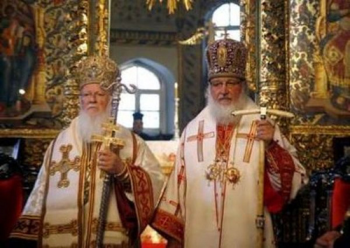
    Yup….remember this picture?

    George Michalopulos and I wondered out loud at the time why the EP looked so pale, ashen…as if he had seen a ghost.

    If you will recall, July 2009, was when the following was announced:

    Patriarch Kirill Meets with Turkish Prime Minister Tayyip Erdogan
    July 9, 2009 9:20 AM John Couretas

    Report from the Department of External Relations, Moscow Patriarchate:

    The head of the Turkish Government expressed satisfaction at Patriarch Kirill’s visit and the fact that he visited not only Istanbul but also the Turkish capital city of Ankara.

    The sides noted with satisfaction the developing relations between the Republic of Turkey and the Russian Federation.

    Mr. Erdogan spoke about his experience of contacts with Russian leaders and the development of bilateral relations including in economy and tourism, pointing out that about three million Russian tourists had visited Turkey in the previous year alone.

    …Patriarch Kirill also spoke about the great number of Russian-speaking Orthodox believers who reside in Turkey. He stressed that churches were needed to meet their religious needs. The prime minister expressed readiness to help in this matter and said that he personally was ready to deal with providing churches for Russian-speaking believers residing in Turkey.

    Pat. Kyrill met with the Turkish Prime Minister and cut this deal. Now, it appears on the website of the Moscow patriarchate, in Russian and Greek only, (no English translation)…and appears in the Greek press…not at all. Talk about trying to avoid a story!

    How long before there are Russian bishops in Turkey?

    I guess overlapping jurisdictions are no longer an American-only pheomenon. Perhaps the EP would like some advice from Metropolitan Jonah on the topic?

    Live by the sword, die by the sword. God definitely has a sense of humor.

    Best Regards,
    Dean

    1. Ilya Kharin

      I guess overlapping jurisdictions are no longer an American-only pheomenon.

      They haven’t been for centuries, with Austria-Hungary at the top of the offending list. But I fail to detect overlapping jurisdictions in this report. Turkey is divided jurisdictionally between the Orthodox Churches of Constantinople, Antioch and Georgia. As the article makes clear

      In 2006 have been collected and handed over to Patriarch Bartholomew over 300 signatures requesting to open in Antalya, a Russian Orthodox church.

      If the Russian Church wished to open its parish in Turkey unilaterally, do you think the parishioners would be asking permission from the Patriarch of Constantinople? I imagine those 300 signatories would have been addressing Patriarch Alexy II instead. Yet, the parishioners petitioned the local canonical first hierarch – the one in Constantinople – and now have a Greek archimandrite for a parish priest. Who does he commemorate at liturgy? Who signed his antimension? I suspect not the Patriarch of Moscow. No parallel jurisdictions in Antalya, it seems.

      1. Geo Michalopulos

        Ilya, if I may spring to Dean’s defense (and meaning no offense to you at all): I believe Dean was engaging in a type of Swiftian satire here. Let me explain. The particulars as you describe them may be true, but what is the end result? Let us not forget, that the Orthodox immigrants who came to America were likewise under the authority of the Russian-American archdiocese but in time, they broke away for various and sundry reasons. Do we have any guarantees that the Russians in Turkey won’t do so? Especially now that they have a Greek rector for their parish. In what language does he serve the divine services? Is this merely an effort to “hellenize” these immigrants? Etc. If so, then these attempts are doomed to failure.

        The Russians are just merely giving the PC a face-saving way out of a morass of his own making. The demographic reality proves that the MP holds all the cards. And in the end, the Chambesy protocols will go the way of all flesh. Otherwise, if they were truly workable, then an Episcopal Assembly would have been created for Turkey. The Russians chose not to press the issue (i.e. the creation of a Russian diocese) at present but I believe it’s an inevitability, just like it will be in Africa. Else, they will simply overwhelm the native patriarchates with Russian bishops. (Further irony alert: at that point the Greek patriarchates may created separate jurisdictions for the Russians just to keep them off the local Holy Synods.) Remember, the Russians consider chess a spectator sport –they’re long-term thinkers.

  2. Andrew

    If the Ecumenical Patriarchate is truly an international institution of dialogue and freedom then there is no reason why there cannot be a non-Greek Ecumenical Patriarch or non-greek members of the Holy Synod. Does the EP even consider the Russian Orthodox in Istanbul part of his flock? part of his omogenia?. If so then I would like to see a Russian bishop with Turkish Citizenship on the Holy Synod.

    The only way to truly save the EP as an institution is to give up on the the EP as a Greek-only institution. Omogenia before Orthodoxy is a failure both in Instanbul and on 79th Street.

  3. Dean Calvert

    Andrew,

    Personally, I think the OCA ought to announce that it categorically rejects any attempt at the rescission of Constantinople’s autocephaly, and will support the ecumenical patriarchate to sustain the same, despite the fact that Constantinople is the smaller church in Turkey (by far), ministering to only a handful of Orthodox. Further, the fact that the Russian Orthodox Church is far larger, and is financially stable, should not be used as a reason to rescind the autocephaly of the smaller entity (Constantinople).

    Furthermore, an Episcopal Assembly should be called in the region, to bring Turkey back into the realm of canonical normalcy, chaired by representatives of the Patriarchate of Constantinople to be sure, in keeping with Chambesy.

    Such plan of reorganization and hopefully union, can be presented to upcoming the Great and Holy Council, right alongside the American plan.

    Best Regards,
    Dean

    1. Geo Michalopulos

      Dean, you took the words right out of my mouth. An Episcopal Assembly for Turkey? One in line with the Chambesy accords? Brilliant! Who says the Lord doesn’t have a sense of humor?

  4. cynthia curran

    True, and also evangelical protestants are growing in Turkey as well as Catholics and Aremians and Russian Orthodox. So, relations changed over time.

  5. Scott Pennington

    Two cents,

    In this and previous reports regarding Pat. Bartholomew’s visit to Russia, the consistent practice of the Russian press releases has been to refer to Constantinople and Moscow as “sister churches” and refer to their respective patriarchs with the same honorific, “Holiness” (rather than “All-Holiness” for Pat. Nartholomew). Furthermore, in the Google translation above, early in the story the Patriarchate of Constantinople is refered to as the “Ecumenical Patriarchate”. This does not appear in the Russian version which simply refers to the “Constantinopolitan Patriarchate”.

    Now, I haven’t reviewed any sizeable number of Russian stories regarding Patriarch Bartholomew, but these descriptions I find interesting. I do not think that the MP is pressing the “Third Rome” idea explicitly, but I do think that the MP does not take Constantinople too seriously and sees them as a smaller, older sister see whose claims regarding its prerogatives they don’t feel continually compelled to dignify with refutation, acknowledgment or in any way. They use their language and thereby express their opinion and don’t really have to be concerned about what Constantinople may or may not do because of the relative weakness of Constaninople vis a vis Moscow. Or, more pointedly, why would they need to claim de jure leadership when they can behave as though they already have de facto leadership? To press an overt claim would make them look small.

    Just my thoughts.

    1. Theodoros

      Happy new year to all,

      The Moscow Patriarchate fully recognizes the Ecumenical Patriarch as “First Among Equals”, as do all the Autocephalous Churches. Patriarch Kyrill, like other Orthodox Primates recognizes the rank of Churches of which Constantinople holds the first place. The name of the Ecumenical Patriarch is read first in the dyptichs by all Primates and then the names of the others are commemorated according to rank (of which Moscow is fifth).

      On his visit to Moscow last year, Patriarch Bartholomew was introduced by a Russian priest at a Seminary as the “First” among Orthodox leaders.

      The Russian Church has no quarrel with Constantinople’s honorary position. The dispute at hand has to do with Constantinople’s meddling in the affairs of other Churches.

      It is Constantinople’s intervention in Russian Church territory that Moscow does not recognize. Russia is not alone in this either. The Church of Greece has also refused to permit Constantinople to interfere on its territory.

      As it is, Moscow and the other Churches accept the Ecumenical Patriarchate’s honorary position as can be seen by the place of honor given to the Ecumenical Patriarch when Orthodox primates are gathered together.

      In any case, the reconciliation between Constantinople and Moscow is a welcome development. Patriarch Kyrill has taken a great interest in the plight of the Greek Orthodox Christians of Constantinople and has used his position to assist the Ecumenical Patriarch.

      It was Patriarch Bartholomew who requested of Patriarch Kyrill that the Russian community in Turkey come under the Phanar, and Patriarch Kyrill agreed with the idea.

      Metropolitan Hilarion has also been outspoken in his support for the Ecumenical Patriarchate. Russian Bishops were present in very important liturgies in Cappadocia and
      at the ancient Monastery of Panagia Soumela in Pontos last year.

      In Cappadocia, Metropolitan Hilarion encouraged Greeks to support the Ecumenical Patriarch and expressed the hope that the Orthodox Church in Constantinople will rise again as the Church in Russia did. ‘

      At the present time, relations between the Churches of Constantinople and Moscow are quite good.

      Happy New Year

      Theodoros

      1. Scott Pennington

        Theodoros,

        It’s not quite as simple as you make it. Moscow categorically rejects Constantinople’s claims under canon 28 of the IVth Council as well as the definition of primacy they propounded at Ravenna. They are definitely not on the same page regarding Constantinople’s status. Nonetheless, you are correct that no one is currently challenging Constantinople’s status as “first among equals” (would that they could remember the “equals” part and quit condescending to all other churches as being the “Mother Church”, which is simply dishonest). “First among equals” is something entirely different than the title “Ecumenical Patriarch” which was introduced centuries after Constantinople was raised to second place on the diptychs and for which Constantinople received great criticism from the then Orthodox pope of Rome – – such that they dared not use the term in correspondence until many centuries later.

        Happy New Year

      2. Dean Calvert

        Hi Ted,

        Good to hear from you…Happy New Year!

        Scott puts a finger on something that I have noticed ever since the trip of the EP to Moscow in May 2010.

        At that time, I noticed a very distinct change in the titles, which implied to me that someone had made a decision in Moscow..it was just too consistent.

        This article continued the pattern of the Russian referring to the EP as simply the “Patriarch of Constantinople” – no “His All Holiness”, no “Ecumenical Patriarch”…simply “Patriarch of Constantinople”.

        I’m not pretending to know what it means…i’m just observing a distinct change in the title, in Russian reports.

        And, as we all know, things like this do not happen by accident.

        Best Regards,
        Dean

        1. Theodoros

          My own feeling is that I am glad that the relationship betweeen Constantinople and Moscow has improved. Orthodoxy has only one weakness,
          and that is the political infighting between different Churches that occasionally erupts into outright cessation of communion.

          Having observed the visit of the Ecumenical Patriarch to Russia, it appears to me that he was received with great reverence and respect from
          the hierarchy of the Russian Church, the Russian government, and the Russian faithful. As to the use of his title by the Moscow Patriarchate,
          I do not know if this means anything, but Moscow has made no moves to my knowledge to displace Constantinople as first in rank among
          the Churches.

          I am one who definitely believes in Moscow as the Third Rome, considering that the Russian Church is the largest of all Orthodox Churches, and
          the Russian government is the most powerful of Orthodox Countries. I am however most pleased that the fighting between these two great
          historic Patriarchal sees has ceased.

          Patriarch Kyrill, who is without question an individual of immense holiness and spirituality has long been a supporter of Christians facing
          persecution. When he was in prior position as Secretary of the Moscow Patriarchate he was very vocal in expressing his support for the Ecumenical
          Patriarchate in its difficulties with the Turkish authorities.

          He has continued his vocal support throught his tenure so far as Patriarch of Moscow so I do not see how or why he would be inclined to insult the
          Ecumenical Patriarch.

          At the Council that took place in 2008 which was attended by the late Patriarch Alexy, Bartholomew I as Ecumenical Patriarch presided without
          any challenge to his role. Patriarch Alexy had previously boycotted similar Pan-Orthodox gatherings owing to the Phanar’s intervention in Estonia
          and Ukraine. Thus, it appears to me that Moscow is not challenging Constantinople with regard to primacy of honor, but of Constantinople’s
          involvement in Ukraine and Estonia.

          Once Constantinople backed off from Ukraine, Moscow adopted a far friendlier posture to Constantinople.

          I am more inclined to judge the situation based on actions and gestures rather than by the formality of titles. If Moscow had claims against
          the Ecumenical Patriarchate, would Bartholomew I have been invited to Moscow and given a prominent reception?

          Would both the Russian Church and government now be so open in championing the cause of the Ecumenical Patriarchate in Turkey?

          I am hopeful that the improvement of relations between Constantinople and Moscow will serve as the basis for a new era in promoting pan
          Orthodox unity and reconciliation.

          Theodoros

          1. Scott Pennington

            I think there is some confusion here about titles versus status vis a vis the diptychs. Pat. Bartholomew would be first among equals regardless of whether he used the title “Ecumenical Patriarch”. We’re talking about two entirely different things. Rome had a primacy of honor during the period when the term “Ecumenical Patriarch” was coined. It has nothing to do with position on the diptychs at all.

            Basically, I don’t have a problem with Constantinople using it because it is essentially meaningless. Yes, Constantinople is currently first among equals. No, it is not and has never been the “Universal Patriarchate” nor is it any longer the “Imperial Patriarchate”. But, since no one outside the Greek world is taking its broader claims seriously, it appears as a harmless anachronism. Nonetheless, it may be that the MP is purposely avoiding the term in order to correct what it perceives to be a somewhat inaccurate ecclesiology coming out of the Phanar.

          2. Ilya Kharin

            Theodoros, I agree with your evaluation of the situation and I have a similar attitude – one of gratitude and hope that the jurisdictional confrontation between Moscow and Constantinople is drawing to a close. It’s a little under a century since Patriarch Meletios of Constantinople took over what had previously been dioceses of the Russian Church in Finland, the Baltic lands and Poland, and did so without consultation with Moscow, in a bid to bolster his global standing in the face of the Greek catastrophe in Turkey. Thereafter the Cold War greatly exacerbated the preexisting confrontation, making Moscow-Constantinople links even more tenuous. After the collapse of the USSR we are finally living in a time where people of all local Orthodox Churches seem to have a chance to leave old delusions behind and place our sonship to God at the center of our lives.

            There is a strange story with the title “Ecumenical” in Russian – at least in the 17-19th centuries in Russia it used to be common to speak of “Ecumenical Patriarchs” as a synonym for “Eastern Patriarchs”, meaning the incumbents of all four ancitent Eastern patriarchal sees. This was a sign of the times – within the Ottoman Empire the independence of the four Patriarchates vis-a-vis each other was limited and the four often acted as one, with Constantinople’s hierarch at the helm of the entire “Roman Orthodox people” in the Ottoman lands. That may be part of the reason why, when speaking of the Patriarch of Constantinople alone, Russian usage has tended to prefer “Constantinopolitan” to “Ecumenical” – simply to avoid confusion with the other “Ecumenical Patriarchs” (i.e. of Alexandria, Antioch and Jerusalem).

            Scott’s observation is well-founded – in my reading of official Russian church news “Constantinoplitan” seems much more common than “Ecumenical” when it comes to current events. But it’s not exclusive. Here is a Russian-language news report from the official website of the Moscow Patriarchate – http://www.patriarchia.ru/db/text/1168097.html. It is dated May 28, 2010, and entitled “Вселенский Патриарх молился за Божественной литургией в Валаамском Спасо-Преображенском монастыре” – literally: “The Ecumenical Patriarch prayed at the Divine liturgy at the Valaam Transfiguration-of-the-Savior monastery.” Although I think Scott’s analysis may be on the mark, Russian avoidance of the title “Ecumenical” doesn’t imply rejection.

          3. Scott Pennington

            In the story to which Ilya linked, the title does contain the Russian words for Ecumenical Patriarch. Also, out of many references in the story, there is actually one place where he is referred to as the “Ecumenical Patriarch”. This is in a direct address by Met. Hilarion. Otherwise it’s “Constantinopolitan” this and that throughout.

            It may not be a conscious tendency, or it may well be. It is certainly a noticeable difference from Constantinople’s self reference. Incidentally, Ilya brings up a good point. It was not just Constaninople that was referred to as “Ecumenical” in the sense of “Imperial”, the term was employed by various imperial and ecclesiastic officials to describe the authority of the bishop of Rome during the fifth, sixth, and seventh centuries.

            I don’t suggest that not using, or rarely using, “Ecumenical” implies rejection of Constantinople in the sense of rejecting communion or rejection of Constantinople’s status as “first among equals”; however, we know Moscow rejects their canon 28 theory and their interference on Moscow’s canonical territory. Also, we know that Moscow refers to Constantinople and the MP as “sister churches”. Under those circumstances, it is not too out in left field to assume that they are trying to be cautious in the language they use so as not to reinforce perceived errors of ecclesiology.

        2. George Michalopulos

          Let’s not forget that “ecumenical” at the time it was coined simply meant “imperial,” not “universal.”

          1. Scott Pennington

            George,

            Maybe, maybe not.

            http://findarticles.com/p/articles/mi_hb6404/is_3_70/ai_n35650541/

            The article is long, but interesting. His conclusions start on page 9, but he suggests that Pope Gregory, at least, justifiably perceived a sense of “universality” in the title.

          2. Ilya Kharin

            The article is thought-provoking and does a good job to show the inherent ambiguity of the term “ecumenical”. The author makes a good point when he indicates the long-established term for “Ecumenical Councils” – certainly, one could hardly equate this term with “Imperial Councils,” inasmuch as their significance is universal. To that one could add such time-honored usage as “Synaxis of the Ecumenical Teachers and Hierarchs: Basil the Great, Gregory the Theologian, and John Chrysostom” – it seems that here the three hierarchs are glorified as universally, not just imperially, significant. On the other hand the term “ecumenical” in the sense of “imperial” is likewise inscribed into the Church’s language from the start via the Bible (Luke 2:1, Acts 17:6). I think the issue is important inasmuch as it revolves around the significance of “The Empire” in God’s plan for mankind. To what extent is the enduring Roman imperial legacy (to which a variety of peoples and civilizations, America included, make a claim) bound up with the life of the Church militant?

  6. Linda

    To say that there is a “sizeable Armenian and Catholic populations in Turkey” is an insult to all the Armenians around the world and the memory of the Armenian Genocide.
    As for the Russians, I think we should be concerned about the % of them who are vulnerable young women forced into the sex trade. By “we” I mean all Orthodox Christians. I understand that the Russian Orthodox Church does not have the funds to deal with this very serious problems with “The Natashas” as Russian prostitutes are commonly called.

Leave a Reply to cynthia curran Cancel reply

Your email address will not be published. Required fields are marked *


Notice: ob_end_flush(): Failed to send buffer of zlib output compression (0) in /home/aoiusa/public_html/wp-includes/functions.php on line 5481