 National Herald
By Theodore Kalmoukos
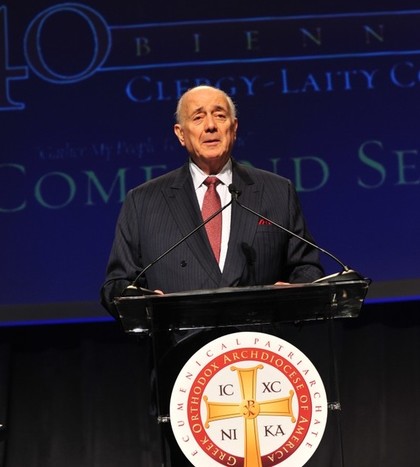
During his address to the 40th Clergy-Laity Congress in Atlanta, Georgia Archdiocesan Council Vice-President Michael Jaharis advocated increased use of the English language and greater efforts to reach out to the youth, converts, and Greek Americans not currently active in the Church.ATLANTA — Archdiocesan Council Vice-President Michael Jaharis proposed using the English language for the Divine Liturgy and other worship services even in parishes comprised largely of Greek speaking faithful, during his address at the 40th Clergy-Laity Congress of the Greek Orthodox Archdiocese of America, which was being attended by Ecumenical Patriarch Bartholomew’s representative Archbishop Irenaios of Crete and hundreds of other delegates from the clergy and laity. At the same time, however, he portrayed himself as a staunch supporter of the Greek language and Hellenism.
Jaharis, the son of Greek immigrants from the village of Aghia Paraskevi in the Greek island of Lesvos, noted in his speech – which contained clear elements of theological and ecclesiastical knowledge and terminology – that although progress in the Archdiocese and great modern achievements both internally and externally are duly noted, he believes that it is equally important to pose the question what needs to be done to build upon this success, to ensure that nothing will impede the ability to achieve continual success in the Greek Orthodox Archdiocese of America. “What must we do in order to continually enable ‘the peopel to gather in our spiritual Home?’ ” he asked.
According to Jaharis, the sole great challenge now facing the Archdiocese is to hold on to the faithful – especially the young people – and keep them linked to and active in the Church. The development and future of the Church in America will depend on the ability to keep young children active in the Church and Community, as well as the ability to welcome those who wish to convert to Greek Orthodoxy, he stressed.
Jaharis, along with the other members of the Executive Committee, are appointed to their positions by Archbishop Demetrios.
During his address, Jaharis also said he wished to make two proposals for consideration and further discussion based on his own personal thoughts and observations. The first proposal dealt with language, and had to do with how the Church could continue to pass on the message of Christ in today’s constantly changing cultural milieu.
The second proposal dealt with educational, cultural, and social examination regarding how to better enable young children to participate in Church and bring them closer to Church and their Greek heritage.
Regarding his first proposal, Jaharis asked the audience how they thought the Church would better be able to help people pray in their native language. He said that he believes the Archdiocese has now reached a point where it can have a growing number of parishes celebrate holy services in English – including parishes comprised of predominantly Greek-speaking congregations. Jaharis argued that today’s reality is that the majority of young parishioners, as well as many older parishioners, together with second and third-generation Greek Americans, along with children from mixed marriages, do not understand the Greek language.
He cited the constantly growing and irreversible trend of interfaith and intercultural marriages, and noted that it is “absolutely imperative to welcome these new couples and their families into the Church, or risk losing them.”
Jaharis also noted that there are far more Americans of Greek heritage living in the United States today than what they appear to be, but that they were not listed in the parish registries. He asked the audience to consider how the Church can reach out to these people and welcome them to their Greek Orthodox spiritual Home, while passing on the message of love and peace in Christ, in a manner that will enable them to fully experience and appreciate the beauty of prayer and the faith. According to Jaharis, if these people cannot understand what is being said in the liturgy, not only will they miss out on a deep and profound spiritual experience, but they will on a greater level lose the foundations and beauty of the faith, culture, and Greek language – a heritage which spans and surpasses two thousand years. He pointed out that the spread of the Eastern Orthodox Faith was achieve through the reliance on various languages aimed at making the Gospel more understandable to new ethnic populations.”
Jaharis also cited the example of Ecumenical Patriarch Bartholomew, which spoke in English during his visit to the U.S. last October. He said that the people ought not to forget that all of the Ecumenical Patriarch’s public addresses were conducted in English during his visit last fall, becasue he wanted to communicate his message directly to the faithful, while remarking that this had a very positive effect.
But Jaharis also clarified that in making this proposal, he was not advocating the uprooting of the Greek language from parishes or parochial schools, but in fact proposing the opposite. He said it was of exceptional importance to preserve the Greek language and cultural programs, and to encourage youngsters to learn Greek. Moreover, he said that the Greek language is aesthetically unsurpassed in regards to its beauty, especially when it is used during supplications and other verses in the divine liturgy.
Still, he stressed that “the Church must be sensitive to the fact that services must be open to all parishioners and that educational programs must be formed in order to meet the needs of young children growing up in the U.S.”
Jaharis also emphasized that now more than ever there was a pressing need to support the already existing Greek language and culture educational programs operating in local parishes, and added that as a founding member of “Leadership 100” and “Faith: An Endowment for Orthodoxy and Hellenism,” he could personally assure the audience that it was this very need to support educational programs for young children that served as the impetus for the establishment of these kinds of endowments.
Elsewhere in his address, he noted that due to the unfortunate economic crisis affecting Greece at the present time and the bleak outlook for the country’s financial future, there is a possibility that it might not be able to continue providing financial support to the Ecumenical Patriarchate. He also referred to the unprecedented growth of the Russian Orthodox Church the great financial contribution it receives. Here in the U.S., he said, Greek Orthodox faithful have been blessed to be able to support themselves and make a significant contribution to the Ecumenical Patriarchate. Nevertheless, he argued that the future of the Church in America depends on its ability to support itself and welcome new members to the faith. He noted that the path that will be chose will undoubtedly define the future of the Greek Orthodox Church, not only in America, but worldwide.
Jaharis also spoke highly of Archbishop Demetios, noting that over the past decade of his service as Archbishop, he has inspired and unified the Church with remarkable ingenuity and passed on his ecumenical philosophy “to serve the Church with the greatest possible respect, pride, and Christian love.”
He also called this Congress was unique because it celebrates two anniversaries. The Independence of the United States and the celebration of the tenth anniversary of Archbishop Demetrios’ tenure as spiritual leader of the Greek Orthodox Archdiocese of America.
Leave a Reply to Andrew Cancel reply