Deprecated: Creation of dynamic property WP_Object_Cache::$global_prefix is deprecated in /home/aoiusa/public_html/wp-content/object-cache.php on line 468

Deprecated: Creation of dynamic property WP_Object_Cache::$blog_prefix is deprecated in /home/aoiusa/public_html/wp-content/object-cache.php on line 469

Deprecated: Creation of dynamic property WP_Object_Cache::$cache_hits is deprecated in /home/aoiusa/public_html/wp-content/object-cache.php on line 475

Deprecated: Creation of dynamic property WP_Object_Cache::$cache_misses is deprecated in /home/aoiusa/public_html/wp-content/object-cache.php on line 476
Archdiocesan Council VP Calls for More English in Church Services – AOI – The American Orthodox Institute – USA

Archdiocesan Council VP Calls for More English in Church Services

National Herald
By Theodore Kalmoukos

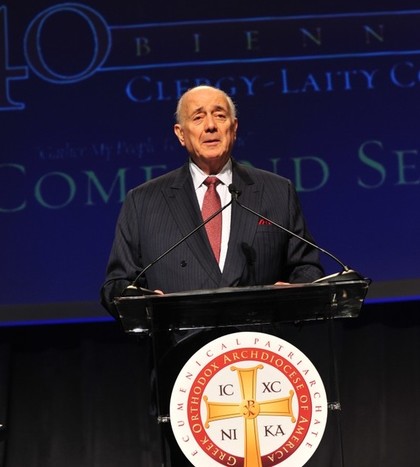
During his address to the 40th Clergy-Laity Congress in Atlanta, Georgia Archdiocesan Council Vice-President Michael Jaharis advocated increased use of the English language and greater efforts to reach out to the youth, converts, and Greek Americans not currently active in the Church.ATLANTA — Archdiocesan Council Vice-President Michael Jaharis proposed using the English language for the Divine Liturgy and other worship services even in parishes comprised largely of Greek speaking faithful, during his address at the 40th Clergy-Laity Congress of the Greek Orthodox Archdiocese of America, which was being attended by Ecumenical Patriarch Bartholomew’s representative Archbishop Irenaios of Crete and hundreds of other delegates from the clergy and laity. At the same time, however, he portrayed himself as a staunch supporter of the Greek language and Hellenism.

Jaharis, the son of Greek immigrants from the village of Aghia Paraskevi in the Greek island of Lesvos, noted in his speech – which contained clear elements of theological and ecclesiastical knowledge and terminology – that although progress in the Archdiocese and great modern achievements both internally and externally are duly noted, he believes that it is equally important to pose the question what needs to be done to build upon this success, to ensure that nothing will impede the ability to achieve continual success in the Greek Orthodox Archdiocese of America. “What must we do in order to continually enable ‘the peopel to gather in our spiritual Home?’ ” he asked.

According to Jaharis, the sole great challenge now facing the Archdiocese is to hold on to the faithful – especially the young people – and keep them linked to and active in the Church. The development and future of the Church in America will depend on the ability to keep young children active in the Church and Community, as well as the ability to welcome those who wish to convert to Greek Orthodoxy, he stressed.

Jaharis, along with the other members of the Executive Committee, are appointed to their positions by Archbishop Demetrios.

During his address, Jaharis also said he wished to make two proposals for consideration and further discussion based on his own personal thoughts and observations. The first proposal dealt with language, and had to do with how the Church could continue to pass on the message of Christ in today’s constantly changing cultural milieu.

The second proposal dealt with educational, cultural, and social examination regarding how to better enable young children to participate in Church and bring them closer to Church and their Greek heritage.

Regarding his first proposal, Jaharis asked the audience how they thought the Church would better be able to help people pray in their native language. He said that he believes the Archdiocese has now reached a point where it can have a growing number of parishes celebrate holy services in English – including parishes comprised of predominantly Greek-speaking congregations. Jaharis argued that today’s reality is that the majority of young parishioners, as well as many older parishioners, together with second and third-generation Greek Americans, along with children from mixed marriages, do not understand the Greek language.

He cited the constantly growing and irreversible trend of interfaith and intercultural marriages, and noted that it is “absolutely imperative to welcome these new couples and their families into the Church, or risk losing them.”

Jaharis also noted that there are far more Americans of Greek heritage living in the United States today than what they appear to be, but that they were not listed in the parish registries. He asked the audience to consider how the Church can reach out to these people and welcome them to their Greek Orthodox spiritual Home, while passing on the message of love and peace in Christ, in a manner that will enable them to fully experience and appreciate the beauty of prayer and the faith. According to Jaharis, if these people cannot understand what is being said in the liturgy, not only will they miss out on a deep and profound spiritual experience, but they will on a greater level lose the foundations and beauty of the faith, culture, and Greek language – a heritage which spans and surpasses two thousand years. He pointed out that the spread of the Eastern Orthodox Faith was achieve through the reliance on various languages aimed at making the Gospel more understandable to new ethnic populations.”

Jaharis also cited the example of Ecumenical Patriarch Bartholomew, which spoke in English during his visit to the U.S. last October. He said that the people ought not to forget that all of the Ecumenical Patriarch’s public addresses were conducted in English during his visit last fall, becasue he wanted to communicate his message directly to the faithful, while remarking that this had a very positive effect.

But Jaharis also clarified that in making this proposal, he was not advocating the uprooting of the Greek language from parishes or parochial schools, but in fact proposing the opposite. He said it was of exceptional importance to preserve the Greek language and cultural programs, and to encourage youngsters to learn Greek. Moreover, he said that the Greek language is aesthetically unsurpassed in regards to its beauty, especially when it is used during supplications and other verses in the divine liturgy.

Still, he stressed that “the Church must be sensitive to the fact that services must be open to all parishioners and that educational programs must be formed in order to meet the needs of young children growing up in the U.S.”

Jaharis also emphasized that now more than ever there was a pressing need to support the already existing Greek language and culture educational programs operating in local parishes, and added that as a founding member of “Leadership 100” and “Faith: An Endowment for Orthodoxy and Hellenism,” he could personally assure the audience that it was this very need to support educational programs for young children that served as the impetus for the establishment of these kinds of endowments.

Elsewhere in his address, he noted that due to the unfortunate economic crisis affecting Greece at the present time and the bleak outlook for the country’s financial future, there is a possibility that it might not be able to continue providing financial support to the Ecumenical Patriarchate. He also referred to the unprecedented growth of the Russian Orthodox Church the great financial contribution it receives. Here in the U.S., he said, Greek Orthodox faithful have been blessed to be able to support themselves and make a significant contribution to the Ecumenical Patriarchate. Nevertheless, he argued that the future of the Church in America depends on its ability to support itself and welcome new members to the faith. He noted that the path that will be chose will undoubtedly define the future of the Greek Orthodox Church, not only in America, but worldwide.

Jaharis also spoke highly of Archbishop Demetios, noting that over the past decade of his service as Archbishop, he has inspired and unified the Church with remarkable ingenuity and passed on his ecumenical philosophy “to serve the Church with the greatest possible respect, pride, and Christian love.”

He also called this Congress was unique because it celebrates two anniversaries. The Independence of the United States and the celebration of the tenth anniversary of Archbishop Demetrios’ tenure as spiritual leader of the Greek Orthodox Archdiocese of America.


Posted

in

by

Comments

9 responses to “Archdiocesan Council VP Calls for More English in Church Services”

  1. Andrew

    Mr. Jaharis is no doubt a highly intelligent and successful man who understands that demography is destiny. However, the question remains as to how the GOA can continue have a budget that has doubled in the last ten years with very little to show for it. Is not fiscal restraint and asceticism in order when it comes to spending?

    This spending problem will impede future attempts at growth. The GOA will not be able to continue to tax parishes and the faithful… the people will resent 79th street’s lack of restraint and tune out and give elsewhere. The longer the GOA kicks the spending can down the road the worse it well get. A modest budget cut this year would have shown every person in the pews that 79th street has to make do with less like everyone else. The proposed budget increase only raises questions of management and stewardship. Much like Greece, 79th street spending cannot be sustained.

    Watching events from the EA to the congress unfold these past months I am also struck by the fact that it is the good will and gifts of Archbishop Demetrios that are literally keeping the peace in America. However, no person can dispute that the Archbishop is an aging man who will one day have to face the question of retirement. In the absence of the Archbishop’s gifts there are many possible scenarios that could arise that may lead to all types of chaos.

    Lets be honest, in order for the tree of Orthodoxy to grown in America and bear healthy fruit it first has to be pruned.

  2. Remove “Greek Orthodox” and replace it with “Orthodox Christian” and substitute the references to the “Greek language and heritage” with “Orthodox Christian moral tradition and heritage”, and you would have a pretty good speech.

  3. The article speaks of financial support for the EP, how much does it cost and how many people are being supported? Does anyone know?

  4. George Michalopulos

    Being at one time a part of the GOA and a two-time delegate to Clergy-Laitys (1998, 2002), I can understand the explosive nature of Jaharis’ speech. For one thing, it couldn’t have been given just ten years ago, probably not even five years ago. (Anytime earlier and he would have been dragged from the podium and tarred and feathered.)

    Although +Demetrios probably cleared it, the officialdom within the GOA no doubt wishes he hadn’t given it. For proof, just go to http://www.goarch.org and read the official take on the Clergy-Laity. Jaharis’ speech is described in only the most vapid terms; we’re talking real spin-city here. In my view, it might have been a warning shot to the Phanar as well, telling them to back off on their plans to remove +Demetrios and/or stop interfering in American Orthodoxy.

    As for the numbers, Andrew, you’re correct in a general sense, however the increase in budget is no doubt driven by the pedophile scandal and the increases to the Phanar. I sense further grumbling among the parishes as well more attrition if the “Atlanta Model” of financing the GOA is implemented throughout the entire archdiocese. (BTW, I have nothing against this model per se, it’s more honest in that it calculates the 15% owed by each parish based on parish expenses, not income. The reason for that is because “income” can be hidded by using two sets of books, whereas expenses are a hard number irrespective of how many books are kept.)

    Ultimately what we are looking at here is an eparchy in crisis. The fact that parishes are forced to hire outside CPAs to present an accurate picture to the archdiocese means that trust has completely broken down in the GOA. With Greece on the skids and funding for the EP drying up in that quarter, look for more pressure on the GOA to keep the Phanar operating.

    1. George, Here you note an echo in the GOA church economics we see on the national stage with public employee unions looking for enhancements from the state and arbitrated by a state employee. When the people deciding their own pay don’t include the people paying for it, little wonder the obligations to pay go up while getting good results from those paid becomes vague and hard to measure.

      Note here that the ‘expense based’ formula ties the largest single expense at the parish – clergy pay and perks – to pay of the folk at the diocesan level who have accounted for zero new faces at the parish all these years nevermind all the money they take.

      The net effect of it all is to ‘spend down’ rainy day and other savings accounts built up at the parish.

      Then pretty soon there will be borrowing against the parish to meet the pay. Then… right.

  5. Dean Calvert

    Mike Jaharis is a well intended guy…he’s proven that to me firsthand.

    The comments may be about 20 years too late, but at least he made them. That’s better than NOT making them.

    There is a vicious cycle to all of this. Keep the services in Greek, the people don’t learn the theology (no understanding of the liturgy and the hymns) the people leave the church because they are disconnected – repeat.

    I honestly doubt the comments will make much of a difference.

    These comments remind me of a pecan company that I flew to Atlanta (ironically) to talk to. They wanted me to come and turn the company around. The owner was an older man, late 70’s. We had a nice morning, he showed me the plant, and then an extended discussion at lunch.

    Around 2:00 he asks me, “Great..so when do we start?”

    “Start?…no, not me. You don’t really want to fix the problem. You just want someone to make it look like you’re trying to fix the problem. That’s not me. The next flight out of Atlanta is at 4:00 and I’ll be on it. good luck.”

    I’m sure the place went under.

    There’s a difference between making a contribution and making a commitment.

    There is no commitment to change at the GOA – until there is, the ship continues in the same, wrong direction.

    Best Regards,
    Dean

  6. Scott Pennington

    ” . . . Jaharis proposed using the English language for the Divine Liturgy and other worship services even in parishes comprised largely of Greek speaking faithful . . .”

    There are actually two different issues here that deserve attention. One is the fact that in GOARCH, many young people marry non-Greeks and there are other non-Greeks who join for whatever reason. Most all of these people neither speak nor understand the Greek of any era.

    A second problem is the fact that the language used in the liturgy isn’t Modern Greek, so even if you teach kids and adults Modern Greek in Greek school (“so that they can write their mother-in-law a letter”), it still won’t result in them understanding most of what is actually said in the service. Look for the original version of Beowulf or the Canterbury Tales and you will begin to see the problem. Even much of early modern English is unintelligible to modern Americans (look at Shakespeare, for example).

    What I have been told by several native speakers is that unless you were schooled in old Greek in elementary or high school (they used two books, one with the liturgy as done, one with a translation into the language they actually spoke) you may get the jist of this or that but you won’t really understand it all, even if you were born and raised in Greece.

    People tend to focus on the first problem, the problem surrounding intelligibility to non-Greeks. This is indeed a factor in couples of mixed Greek-Orthodox and non-Greek backgrounds, especially if one of the spouses was not Orthodox of any variety before the marriage. At most every Greek church you could make a list of young people who left GOARCH because the non-Greek spouse simply could never feel at home or a part of the community.

    But focusing on the first problem exclusively is to make the assumption that those of Greek ancestry should be fine with old Greek in the service since it’s somehow “their language”. Historically that may be true. But in terms of intelligibility that is rarely the case.

    Once I sang a communion hymn at my former church called, “Aghaliasthe dhikei”. It’s only sung on one occasion during the year normally. An American born Greek lady who spoke Greek came up to me later and said, “That was beautiful! Was it Russian?” Now, at other times I have been complimented on the way I pronounce Greek, so I don’t think that was the problem.

    Really there are two problems masquerading as one: 1) will non-Greeks feel at home in GOARCH and 2) will anyone understand the actual words of the liturgy, regardless of their ethnicity or native language.

    That is why I sense that Jaharis’ point is important. “[E]ven in parishes comprised largely of Greek speaking faithful”, so long as they also speak English, the most efficient way of actually communicating the faith through the liturgy may well be to do it in English. If they speak Greek and not English, perhaps the Archdiocese should seriously consider translating the liturgy into Modern Greek or to teach Byzantine Greek and Koine in Greek school. This would have the additional value of the laity being able to access Scripture, the canons and the Fathers in the original.

    The same problem exists in Slavic churches. I don’t mean to single out the Greeks.

  7. Geo Michalopulos

    Scott, Dean, your observations are on the mark, certainly more expansive than my own. Ultimately, the question comes down to: whose Church is it? If it’s a colonial outpost, then no matter how many speeches Jaharis and others like him make, it will be for naught.

    You know, HB +Jonah indicted American Orthodoxy in general during his inaugural speech. He asked “where were the Orthodox medical clinics, soup kitchens, etc. here in America?” We never will get there until we answer the question. With the election of +Jonah, the OCA for its part has answered the question. “We’re an American Church.”

    If I may expand on this –and Harry, you’ll appreciate this–the election of +Jonah has created the opening needed to elect new bishops. We saw this in Pittsburgh with the election of +Melchisedek and are seeing it now in Chicago being played out. I heard that this model will be submitted to the Holy Synod for approval as the permanent method for the electcion of local bishops.

  8. George Michalopulos

    Looks like Jaharis’ speech is indicative of a wider problem. According to The National Herald, 2/3 of the priests of the Boston GOA diocese chose to defy their bishop and not attend the Clergy-Laity. They were very brazen about it. One of them remarked that language “wasn’t an issue.” Also the most recent TNH editorial talked about the incipient stages of a “schism” within the GOA (their words, not mine), basically along these ethnic/linguistic fault-lines.

    Personally, the fact that they spoke on the record to Kalmoukos tells me that they aren’t scared of any repurcussions from their bishop. Perhaps they feel he’s a paper tiger? Or are they daring him, hoping to start a schism?

    I don’t know how this is going to ultimately shake out but I can honestly say that under these conditions, a complete unification of all parishes in North America is a complete impossibility. Most likely the more ethnic parishes within the various jurisdictions will schism off and form their own diocese if they fail in keeping the current jurisdictions sufficiently ethnocentric for their tastes. This is more than Greek ethnocentrism however. Right now, i don’t see how those four Arab parishes in the Toledo diocese that defied Bishop +Mark last year would ever accede to being part of a united American church, if that meant reporting to a non-Arab bishop.

    Anyway, that’s my take. I hope I’m wrong.

Leave a Reply

Your email address will not be published. Required fields are marked *


Notice: ob_end_flush(): Failed to send buffer of zlib output compression (0) in /home/aoiusa/public_html/wp-includes/functions.php on line 5481